A used concert sound system for sale from China is priced per unit, typically between USD 1,200 and USD 6,000 per line-array module, and the practical question is not whether it is cheap but whether the rigging hardware, amplifier modules and connection panels are confirmed on the specific listing you are buying. Treat the price as a starting point for a landed-cost calculation, not as the answer.
Quick answer
For volume buyers — KTV chains, touring companies, rental houses, bars and clubs — used line-array modules in Grade A condition are a realistic way to build or expand a system at a fraction of new pricing. The catch is that the published specification rarely covers the parts that fail: amplifier modules, driver originality, rigging wear and connector condition. Buy only after the per-unit price, the included accessories and the inspection standard are all written down.
Key takeaways
- Published price band for this category is USD 1,200 to USD 6,000 per unit — a wide range that reflects brand, model and condition, not negotiation room alone.
- Grade A in our own grading language means used equipment that has passed inspection; it does not mean new, and it does not mean cosmetically perfect — one mina/" class="inline-link">MINA listing explicitly notes scuffs and scratches on cabinet and rigging hardware.
- What ships with the module changes the real cost: some listings include rigging frames and cabling, others include rigging hardware and connection cables, and the CAF listing states rigging hardware included while the MINA listings differ from each other.
- Self-powered modules carry amplifier electronics inside the cabinet, so the amplifier module is part of what you are buying and part of what can fail.
- Certification, warranty, service history and lead time are not disclosed in the materials available — plan around that gap rather than assuming.
The decision
You are a rental house in Russia, a KTV operator in the Middle East, a touring company in South America or a club in Africa, and you have a quantity in mind — eight modules, sixteen, a full hang per side. You have a budget per unit and a shipping quote to your port. The decision in front of you is whether to commit a deposit on a bulk lot of used line-array modules from a Chinese supplier, or to hold the money and buy fewer new units.
That decision turns on three things you can actually check: the condition grade and what it covers, the accessory list per listing, and whether an inspection report will exist before money moves. Everything else — brand prestige, cosmetic appearance in photos, the seller's description of 'like new' — is noise at this stage.
What the data says
The materials give a category price band of USD 1,200 to USD 6,000 per unit for line-array equipment. Individual product prices are not published on the listings, so any per-model figure you see quoted elsewhere is not from us.
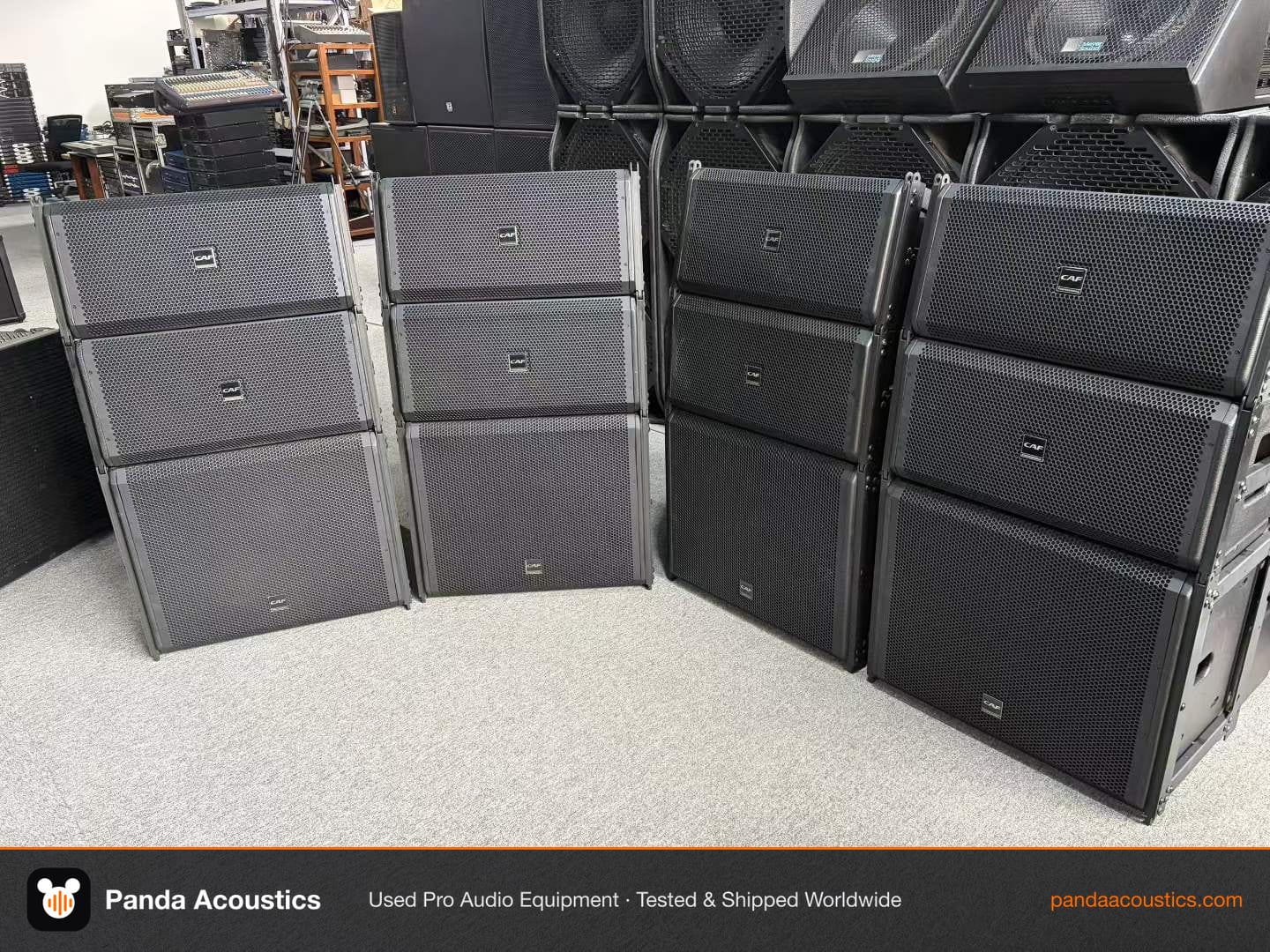
On the CAF side, the listing describes line array speaker modules in used Grade A condition, black, with a metal front grille, rigging hardware included, a rear connection panel with model labels, and modules stacked in groups. That is a compact, factual description — it tells you the hardware is present and the panels are labelled, which matters when you are matching modules across a bulk order.
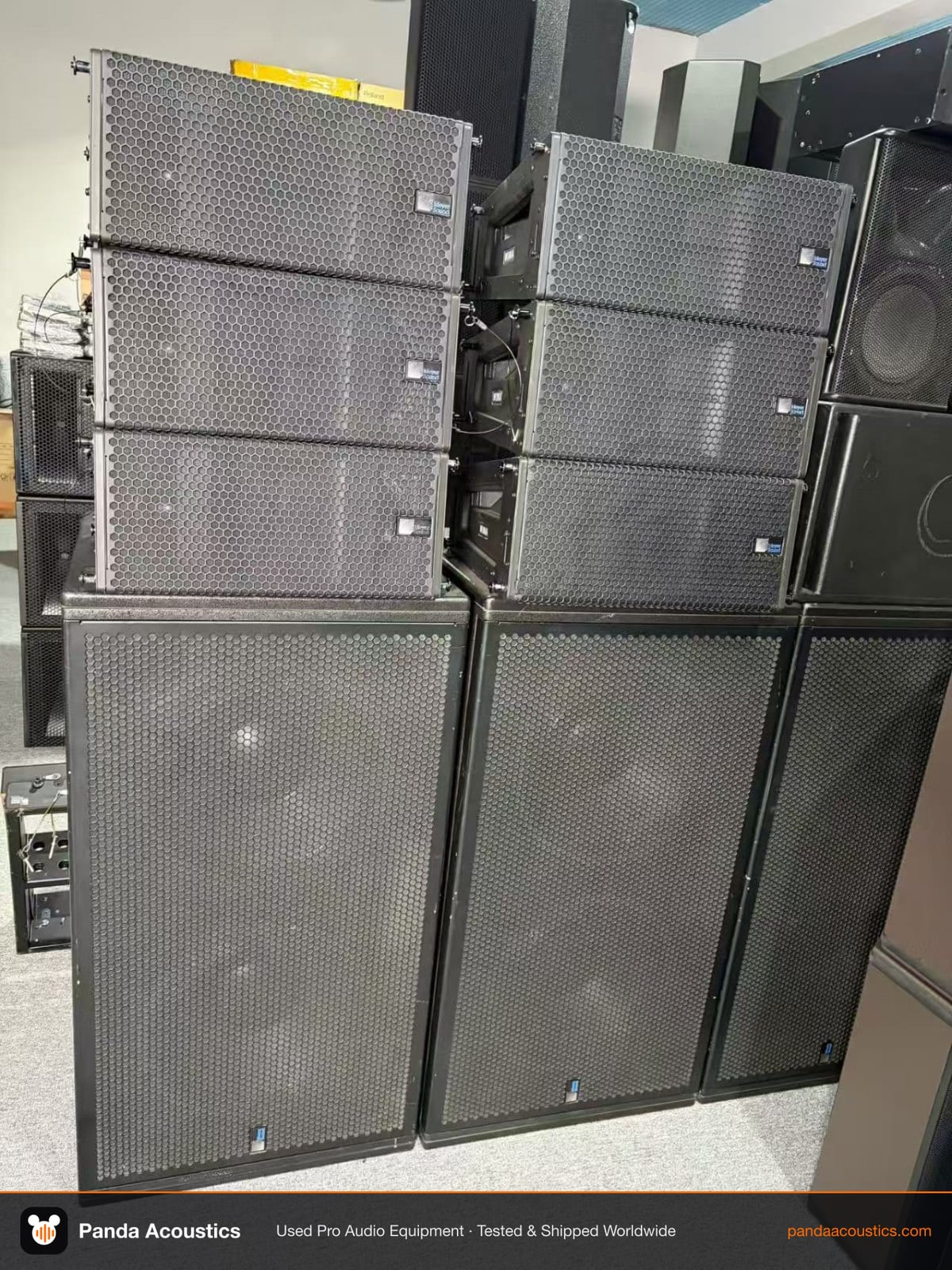
On the Meyer Sound side, the MINA appears in several listings. One describes a compact line array loudspeaker in Grade A used condition with a 600-HP amplifier module, hex-punched steel grille, black finish, and rigging frames and cabling as shown. Another describes the same model with rigging frames and safety steel cables fitted and an amplifier module with cable connections on the rear panel. A third describes a self-powered line array module with NL4 connectors, honeycomb metal grille, Grade A used condition with scuffs and scratches on cabinet and rigging hardware, and rigging hardware and connection cables included.
Read those three descriptions side by side and the lesson is immediate: the same model number does not mean the same bundle. Accessories, connector type and cosmetic notes differ. For a bulk order that is the difference between a working hang and a shopping list of missing frames.
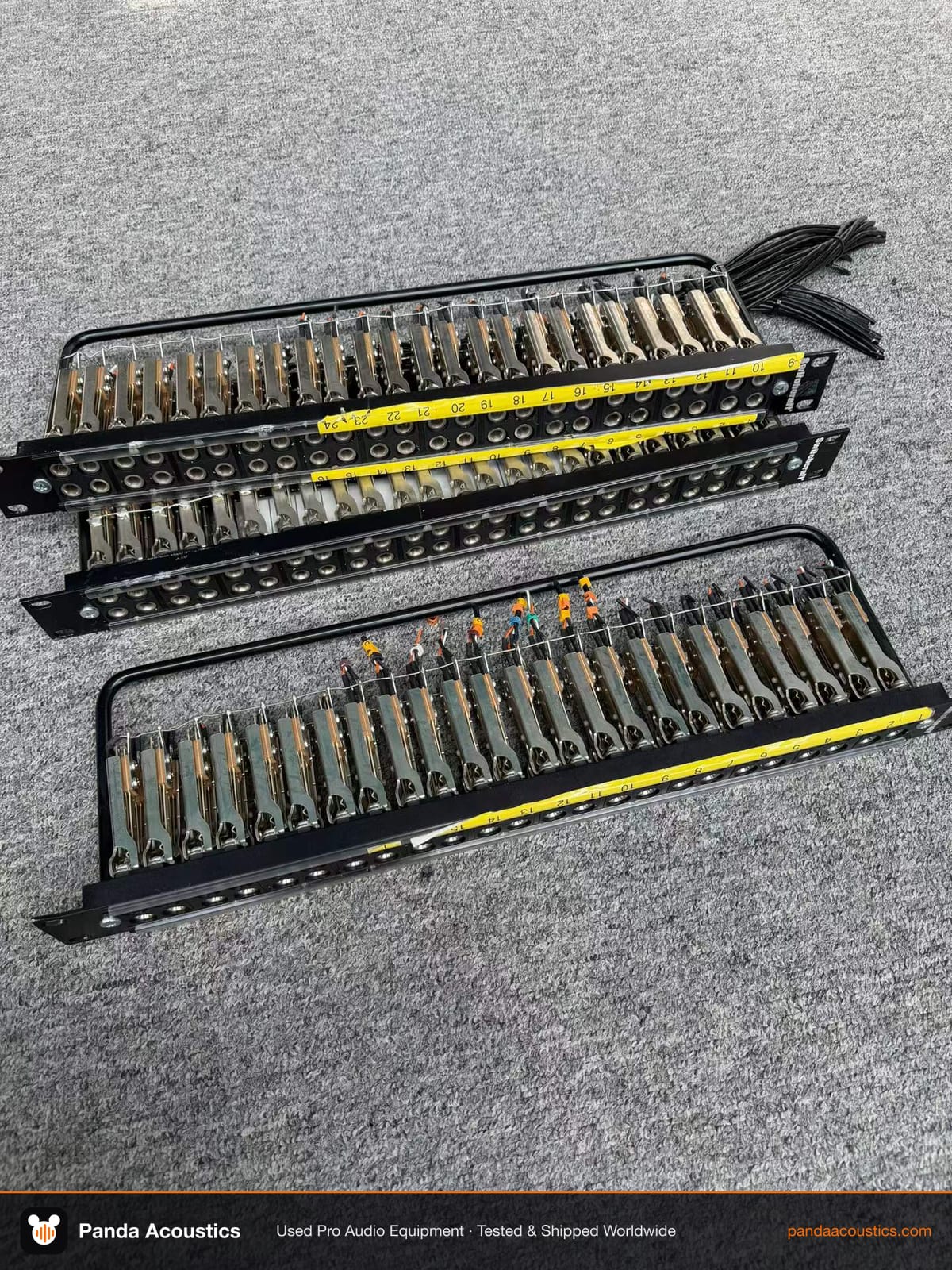
The catalogue also includes adjacent items you may need to complete a system — a Switchcraft 24-channel rack-mount audio patch panel with 1-24 channel numbering visible on panels, 1/4-inch jack sockets, mounting ears present, and rear termination as bundled black cable with unsoldered bare wire ends; and an unbranded LED stage light with barn doors, DMX IN/DMX OUT, POWER IN/POWER OUT and a 4-digit LED display. Neither is a concert system component in the line-array sense, but both show the level of detail our listings publish, and both show where detail stops.
What the datasheet/docs don't tell you
Several things that decide whether a used concert system is a good buy are simply not in the materials.
- Amplifier module service history — not disclosed. A 600-HP module is named on one MINA listing, but its hours, repair history and current test results are Unknown. Self-powered modules make this the single largest hidden risk.
- Driver originality — not verified in the published specs. Whether the cones and diaphragms are original or replaced is Unknown per listing.
- Warranty — not disclosed. Do not assume any period.
- Lead time and stock depth per model — stock status is listed as in-stock, but quantity available per model is Not disclosed.
- Certification — no CE, RoHS, UL, FCC or ISO claim appears in the materials. If your market requires a certificate, that requirement is Not applicable to anything stated here and must be raised directly.
- Cosmetic grade boundaries — Grade A is defined by our grading standard, but the exact tolerance for scuffs on rigging hardware is best read on the grading page rather than inferred from photos.
Why it matters: a landed-cost model built on a USD 1,200 to USD 6,000 per-unit band collapses if two of sixteen modules need amplifier repair, or if rigging frames must be sourced separately. Unknowns are cost, not comfort.
Who should not choose this
Do not buy this if you need a certified, warrantied system with documented service history — that is not what the materials describe, and no certification is claimed. Do not buy if you cannot inspect, or arrange inspection against a written standard, before paying; used line-array modules are exactly the category where an unseen amplifier module is an expensive surprise. Do not buy if your project requires a fixed delivery date, because lead time is Not disclosed. And do not buy a single module to 'test the seller' — line arrays are sold and rigged in groups, and one cabinet proves very little about a lot.
Comparison and trade-offs
Within the materials, the honest comparison is between listings, not between brands.
- CAF modules — Grade A, black, metal grille, rigging hardware included, labelled rear connection panel, stacked in groups. The published description is consistent and hardware-inclusive.
- Meyer Sound MINA (listing A) — Grade A, 600-HP amplifier module, hex-punched steel grille, rigging frames and cabling as shown.
- Meyer Sound MINA (listing B) — Grade A, rigging frames and safety steel cables fitted, amplifier module with cable connections.
- Meyer Sound MINA (listing C) — self-powered, NL4 connectors, honeycomb metal grille, Grade A with scuffs and scratches on cabinet and rigging hardware, rigging hardware and connection cables included.
The trade-off is straightforward. A listing that names the amplifier module and includes rigging frames reduces your accessory spend; a listing that flags cosmetic wear on rigging hardware tells you where to look during inspection. Neither tells you how the module performs, because performance data is not published. Compare on disclosed facts and price band, then let inspection settle the rest.
Implementation / next step
Before any deposit, do this in order. First, shortlist the exact listings and record the model, condition grade and included accessories for each — use the line-array category page to see what is actually offered. Second, read the condition grading standard so you know what Grade A does and does not promise. Third, read the inspection standard and confirm in writing which checks will be performed on your lot. Fourth, request a shipping quote to your port via the shipping and logistics page so the landed cost per unit is real. Fifth, confirm payment terms before committing quantity.
Concrete next step: pick two listings — one CAF module lot and one Meyer Sound MINA lot — and request a written quotation that states per-unit price within the USD 1,200 to USD 6,000 band, the exact accessories included, the inspection checks to be performed, and the shipping cost to your port. Do not send a deposit until that document exists.