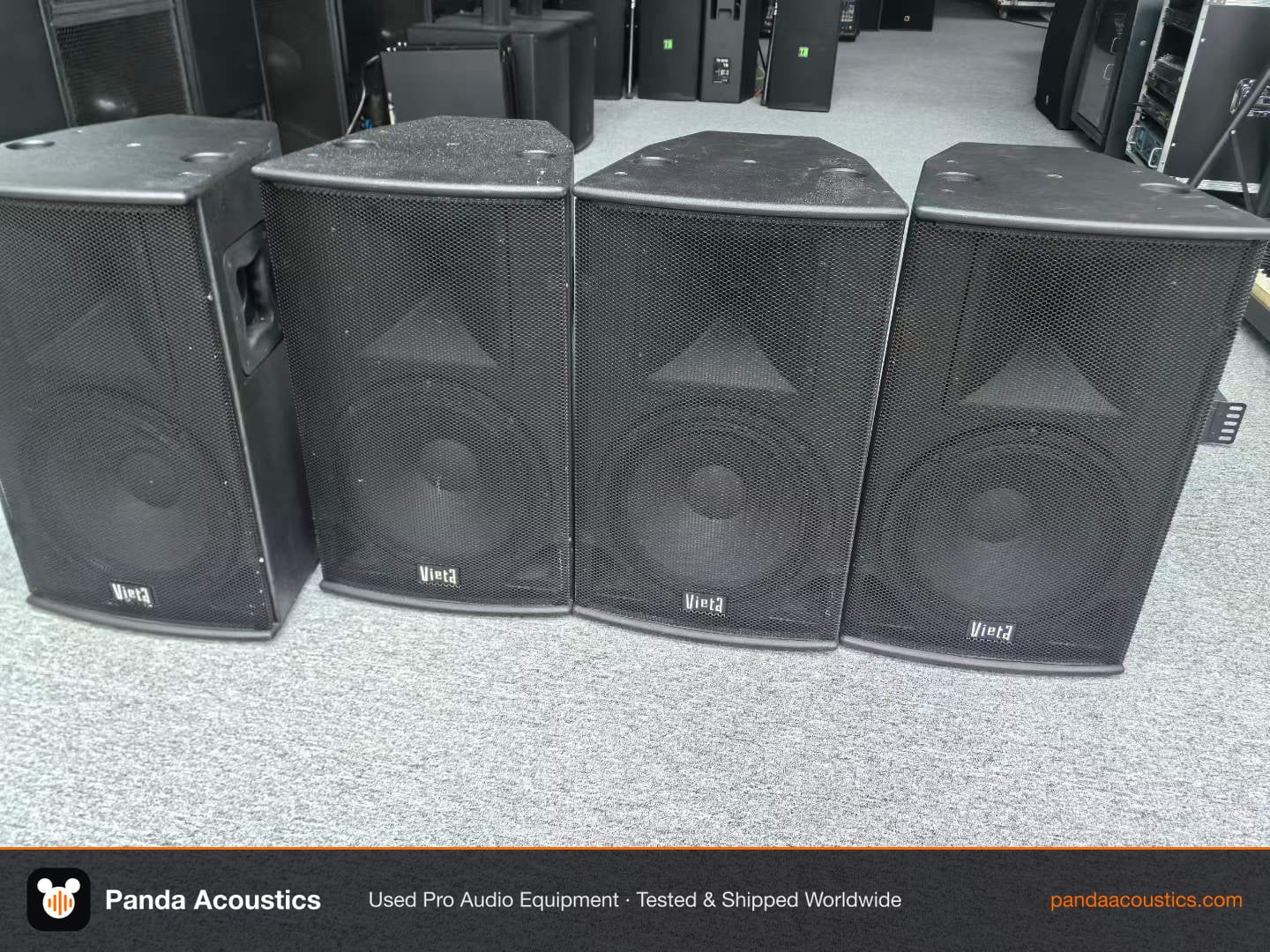
The Vieta VT-12 is a passive two-way full-range speaker rated at 250W RMS into 8Ω, fitted with 2x Speakon IN/OUT connectors, and offered in Condition A as in-stock used stock. It is worth buying used in bulk only if you confirm driver and crossover condition on the actual units and your amplifiers are matched to 250W at 8Ω; if you need active boxes, published pricing, or a documented warranty, this is not your model.
Key takeaways
- The VT-12 is a passive box: 250W RMS, 8Ω, 2x Speakon (IN/OUT). You supply amplification.
- It ships as Condition A and in-stock per the listing, with the grading definition set out on the condition grading standard page.
- Crossover parts are documented by part number: GDSL1017 1.4mH/5A and GDSL1006 0.5mH/5A.
- Country of manufacture is listed as Made in EC; the VT-series is the product family.
- Price is not published per unit. The only figure available is the site-wide used speaker band of USD 200–1500 per unit.
The decision
You are sourcing speakers in volume for a KTV room build-out, a rental fleet, or a bar and club install in Russia, the Middle East, South America or Africa. You are not shopping for one box; you are deciding whether a container or a pallet of VT-12s is the right inventory line, and what has to be true before money leaves your account.
That decision has two halves. The first is fit: a passive 8Ω box means every VT-12 needs an amplifier channel and a cable run, and your amp budget is part of the landed cost. The second is condition: used passive speakers fail at the driver, the crossover, or the connector, and those are the three places a bulk buyer has to get answers in writing. The inspection standard page describes how Panda Acoustics frames that check; read it before you negotiate, not after.
What the data says
These are the only figures published for this model, and they are worth reading carefully because the list is short.
- RMS Power: 250W.
- Impedance: 8Ω.
- Series: VT-series.
- Connectors: 2x Speakon (IN/OUT), so boxes can be chained.
- Crossover inductors: GDSL1017 1.4mH/5A and GDSL1006 0.5mH/5A.
- Country of manufacture: Made in EC.
- Condition: A, in-stock.
- Price: not published; the site-wide used speaker band is USD 200–1500 per unit.
Two things follow from that list. First, the crossover is documented at component level, which is unusual for a used listing and is useful: if a box arrives with a replaced or missing inductor, you can see it against the part numbers. Second, the 8Ω rating and the Speakon IN/OUT pair mean the VT-12 is designed to be paralleled across a chain, so your amplifier load calculation has to account for how many boxes you hang on one channel. The speaker category page shows the rest of the passive and active stock you can compare against.
What the datasheet/docs don't tell you
Several things a bulk buyer actually needs are not disclosed in the materials, and each one carries a cost if you assume instead of asking.
- Frequency response, sensitivity and maximum SPL: Unknown. Without sensitivity you cannot estimate how much amplifier headroom a room needs, and without response data you cannot judge whether the box suits vocal-forward KTV work or full-range music playback.
- Driver make, model and condition per unit: Not disclosed. Condition A is a grading band, not a driver test result. Ask what the grading page requires and what the inspection page records.
- Unit price and volume price breaks: Not published. The USD 200–1500 band is a category range, not a quote for the VT-12.
- Warranty, lead time and MOQ: Not disclosed. Do not assume any of these; they are commercial terms you negotiate, and the payment terms page is the place to start.
- Certification: No CE, RoHS, UL or FCC claim appears in the materials. If your market requires a certificate, treat it as unverified until you have a document.
- Age and service history: Unknown. Grille dents and reconed drivers look similar in a photo and behave very differently in year two.
The reason this matters is arithmetic. At a category band of USD 200–1500 per unit, a single replaced driver or a dead crossover can absorb a meaningful share of the unit's value, and in a bulk order that multiplies across every box. The unknowns are exactly the variables that decide whether the landed cost is a bargain or a repair bill.
Who should not choose this
Do not buy the VT-12 if any of the following describes you.
- You want powered boxes. The VT-12 is passive at 8Ω. If your plan assumes built-in amplification, every unit adds amplifier and cabling cost you have not budgeted.
- You need a fixed published price before you commit. Price is not published for this model. If your procurement process cannot proceed without a listed unit price, this listing will stall it.
- You need a documented warranty or certification package. Neither appears in the materials. Buyers in markets that require certification should not treat this as a compliant purchase until documents are produced.
- You are buying for a single small room and cannot inspect. One box with an unknown driver history is a poor bet; the value of a bulk purchase is that inspection and grading are applied across a batch.
- You need sub-bass extension from the same box. Nothing in the materials describes low-frequency performance, so do not plan a system around an assumption.
Comparison and trade-offs
Staying strictly inside the published facts, here is how the VT-12 sits against other in-stock Condition A speakers in the same catalogue.
- Vieta VT-12 vs JBL KP4010: both are 8Ω passive boxes with 2x Speakon connectors (IN/OUT on the VT-12, IN/THRU on the KP4010). The VT-12 publishes 250W RMS; the KP4010's power rating is not disclosed in the materials. The KP4010 is listed as made in China, the VT-12 as Made in EC. The KP4010 belongs to the KP4000 series; the VT-12 to the VT-series.
- Vieta VT-12 vs RCF ART 310A: the ART 310A is listed as an active two-way speaker pair, so it carries its own amplification; the VT-12 does not. The ART 310A listing documents a compression driver model (ND1411-M ART 310A) and two crossover capacitors (ROYAL403 20W 6.25J, ROYAL573 20W 2.5J). If your site has no amplifier infrastructure, the ART 310A removes a cost line that the VT-12 adds.
- Vieta VT-12 vs dynaudioacoustics BM5: the BM5 is a two-way studio monitor pair at 4Ω nominal, rated for 50–100 RMS watts of amplifier power, made in Denmark. It is a monitoring product, not a PA box, and its impedance differs from the VT-12's 8Ω. Do not mix them in one amplifier plan.
The trade-off in one line: the VT-12 gives you a documented passive box with a known crossover parts list and a known power and impedance figure, and asks you to bring amplification and to resolve the unknowns yourself. Active alternatives remove the amplifier question but change the cost structure and, in the ART 310A case, come as pairs.
Implementation / next step
Before you pay, do this in order. Open the Vieta VT-12 listing and confirm the published figures match what you were quoted. Then request, in writing, the per-unit inspection record for the batch you are buying: driver condition, crossover condition against the GDSL1017 and GDSL1006 part numbers, and connector condition. Ask explicitly for the unit price, the volume break, the lead time, and whether any warranty is offered, since none of these are published. Finally, confirm your amplifier plan: 250W at 8Ω per box, and a load calculation for however many boxes you intend to chain on one channel.
If the seller cannot produce a per-unit inspection record and a written unit price, do not send payment. That single request separates a real bulk offer from a listing.