A KTV sound system for 20 rooms is a volume purchase: you are buying roughly 40 main speakers plus shared processing and amplification, and tested used speakers in the USD 200–1,500 per-unit band can cover it if you verify condition grade, serial numbers, impedance and voltage before paying. There is no single package price published for a 20-room build, so treat any per-room figure as Unknown until you have a quoted bill of materials.
Key takeaways
- Used speaker pricing on our catalogue sits in a USD 200–1,500 per-unit range; a 20-room KTV typically needs two main speakers per room, so the speaker line alone is a 40-unit decision.
- Condition is graded, not assumed: the Vieta VT-12, JBL CMX6403, RCF ART 310A and others are listed as condition A, and the Barefoot Sound MicroMain27 listing notes minor dust and light handling wear.
- Serial numbers are published on some listings (Meyer Sound HD-1 07342740, dynaudioacoustics BM5 849635), which is what you use to confirm the exact unit you are paying for.
- Voltage matters for export: the Meyer Sound HD-1 is listed at 90-130 V / 200-250 V, which is the kind of detail to confirm per model before shipping to Russia, the Middle East, South America or Africa.
- Studio monitors and column arrays are listed in the same catalogue but are not the default KTV room speaker; match the model to the room's vocal and playback use.
The decision in front of you
You operate or are building a 20-room KTV, and you are deciding whether to furnish the rooms with tested used professional speakers bought in bulk from China rather than new boxes or a local integrator package. The decision is not only about unit price. It is about whether 40 units of a specific model can be supplied at a consistent condition grade, with serials you can check, at a voltage and connector standard your rooms can use, and at a total landed cost you can defend to your partners.
That decision has a deadline and a cash exposure. A 20-room rollout usually means a deposit on a large unit count, freight across borders, and installation labour booked in advance. If the speakers arrive mismatched or in worse condition than described, the schedule slips and the rooms stay dark. So the useful question is narrower than "which KTV system is best": it is "which used speaker model can I verify, in the quantity I need, before I release payment".
What the data says
Everything below comes from our published listings and policy pages. Nothing here is a measured performance claim.
- Price band for the speaker category: USD 200 to USD 1,500 per unit. Individual listing prices are not published.
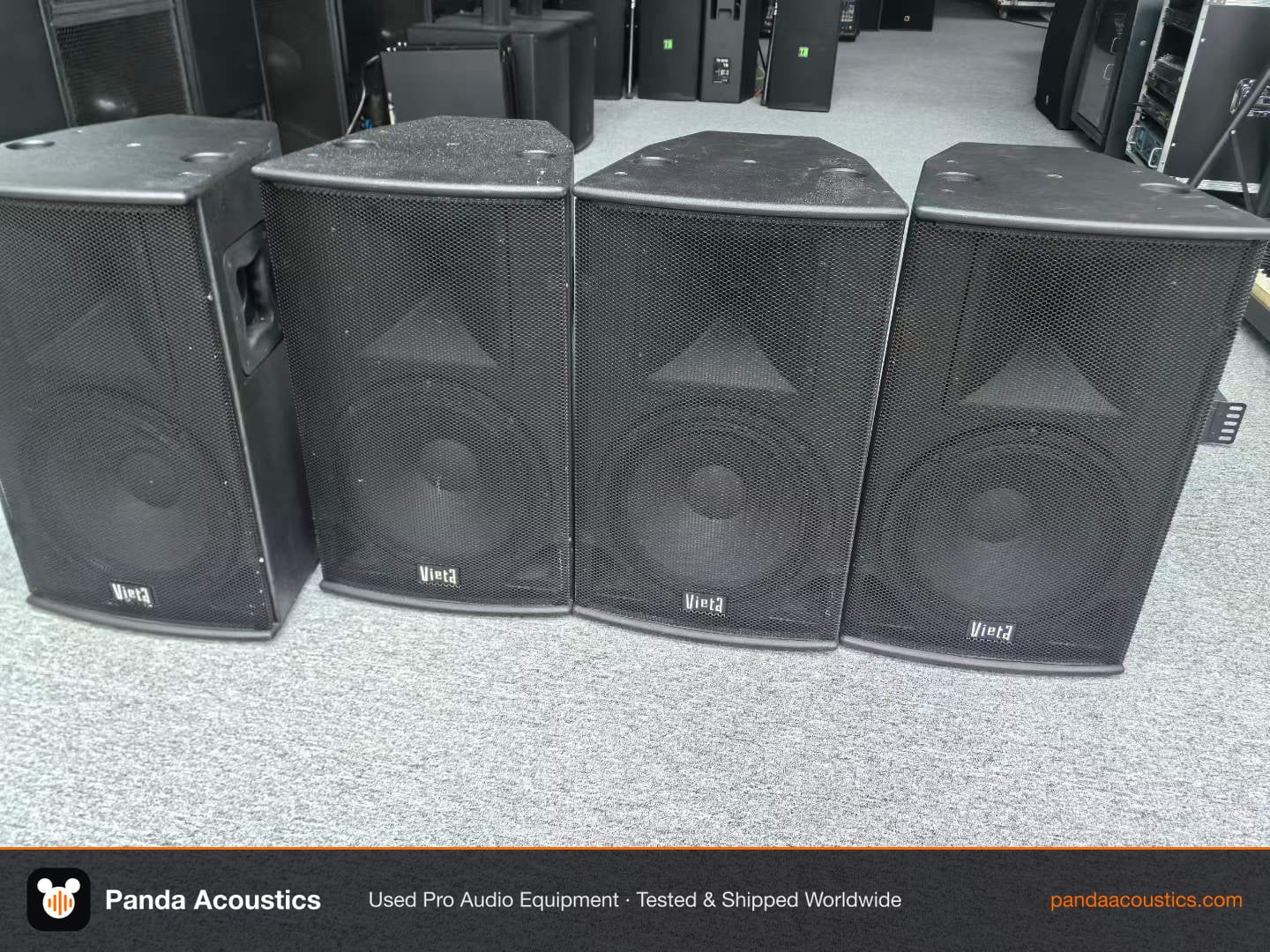
- Vieta VT-12: two-way full-range speaker, 250W RMS, 8Ω, VT-series, 2x Speakon IN/OUT connectors, crossover inductors GDSL1017 1.4mH/5A and GDSL1006 0.5mH/5A, made in EC, condition A, in stock.
- RCF ART 310A: active two-way speaker sold as a pair, condition A, in stock, with compression driver ND1411-M ART 310A and crossover capacitors ROYAL403 20W 6.25J and ROYAL573 20W 2.5J.
- JBL CMX6403: column array speaker, 8 ohms, condition A, in stock.
- Meyer Sound HD-1: high definition audio monitor sold as a pair, serial 07342740, voltage 90-130 V / 200-250 V, fuse 5 A / 3.15 A, XLR input, condition A, in stock.
- dynaudioacoustics BM5: two-way studio monitor pair, 4 ohms nominal, 50-100 RMS watts amplifier power, serial 849635, made in Denmark, condition A, in stock.
- Barefoot Sound MicroMain27: active studio monitor pair, hand crafted in the USA, XLR inputs, volume control, condition grade A with minor dust and light handling wear, in stock.
For a 20-room build, the arithmetic is simple and unforgiving: two main speakers per room is 40 units before you count any shared equipment. At the low end of the band that is a different budget conversation than at the high end, and the model you choose moves you along that band. The VT-12 and RCF ART 310A are the listings closest to a room-speaker role; the HD-1, BM5 and MicroMain27 are monitor-type products, and the CMX6403 is a column array. Each is in stock and graded A, but they are not interchangeable in a KTV room.
What the listings and docs don't tell you
Several things you need for a 20-room decision are simply not in the materials, and you should treat them as open items rather than assume them.
- Unit price per model: Not disclosed. Only the category band of USD 200–1,500 is published.
- Minimum order quantity and volume discount tiers for 40 units: Not disclosed.
- Warranty period and what it covers: Not disclosed.
- Lead time from order to dispatch, and transit time to your country: Not disclosed.
- Certification status (CE, RoHS, UL, FCC, ISO or similar): not stated in the materials, so do not assume any.
- Amplifier and processor pairing for a full room system: not specified per model.
- Coverage, SPL and room-acoustic suitability for a KTV-sized room: not stated, and not something to infer from the model name.
Why this matters: a 20-room purchase is a repeat purchase of the same model, so any unknown becomes a multiplied unknown. If the warranty is undefined, you are self-insuring 40 units. If the MOQ and discount structure are undefined, your per-room cost estimate is provisional. If certification is undefined, your import clearance may depend on documents you have not yet seen. The grading and inspection pages are the place to start closing these gaps, because they define what condition A means and what is checked before dispatch.
Who should not choose this
Do not take this route if you need a turnkey KTV package with a published warranty, named certifications, and a fixed delivery date written into the contract. The materials do not provide those, and a 20-room opening cannot absorb that uncertainty.
Also step back if you cannot verify serials and condition before payment, or if your rooms are already wired for a proprietary amplifier and processor ecosystem that these speakers do not match. And if your plan is to use studio monitors such as the BM5 or MicroMain27 as the main room speaker for a KTV, stop: those are monitor products, and nothing in the materials supports them as a 20-room KTV room speaker. Buyers who need one invoice, one brand, and one support line should go to a new-equipment integrator instead.
Comparison and trade-offs
Within our own listings, the trade-offs are about role, not brand prestige.
- Vieta VT-12 versus RCF ART 310A: the VT-12 is a passive two-way at 250W RMS and 8Ω with Speakon IN/OUT, so it needs external amplification; the ART 310A is an active two-way pair, which changes your amplifier count and rack space. Both are condition A and in stock.
- JBL CMX6403 versus the two-way boxes: the CMX6403 is an 8-ohm column array. A column array distributes sound differently from a point-source box, so it suits a different room geometry; the materials give no coverage figures, so this is a design question, not a spec comparison.
- Meyer Sound HD-1 versus dynaudioacoustics BM5 versus Barefoot MicroMain27: all three are monitor-type pairs with XLR inputs. The HD-1 lists dual voltage 90-130 V / 200-250 V, the BM5 lists 4 ohms and 50-100 RMS watts amplifier power, and the MicroMain27 is an active pair hand crafted in the USA. None of these listings states KTV room suitability.
The honest trade-off is this: the models closest to a KTV room role (VT-12, ART 310A) are also the ones where you must confirm amplifier matching and connector standards, while the monitor models carry clearer electrical labels but the wrong intended use. Price within the USD 200–1,500 band is not published per model, so you cannot rank them on cost from the materials alone.
Implementation: what to do before paying
Build a one-page verification sheet per model and fill it in before any deposit.
- Confirm the exact model and quantity for 40 units, and ask for the per-unit price in writing against the USD 200–1,500 band.
- Request the serial numbers for the actual units allocated to your order, the way the HD-1 and BM5 listings publish serials, and check they match on delivery documents.
- Read the condition grading standard and the inspection standard, then ask which checks were performed on your batch and what the report contains.
- Confirm voltage and connector requirements for your destination, using the HD-1 dual-voltage label as the example of what to look for.
- Get the shipping and logistics terms in writing, including who handles export documents and what happens if a unit fails on arrival.
- Confirm payment terms and whether any inspection or escrow step is available before the balance is released.
Next step: open the speaker category page, shortlist one room-speaker model and one backup, and send a request for a 40-unit quotation with serials, condition report and shipping terms attached.
Related pages
- Used speaker equipment
- Full used equipment catalogue
- Vieta VT-12 listing