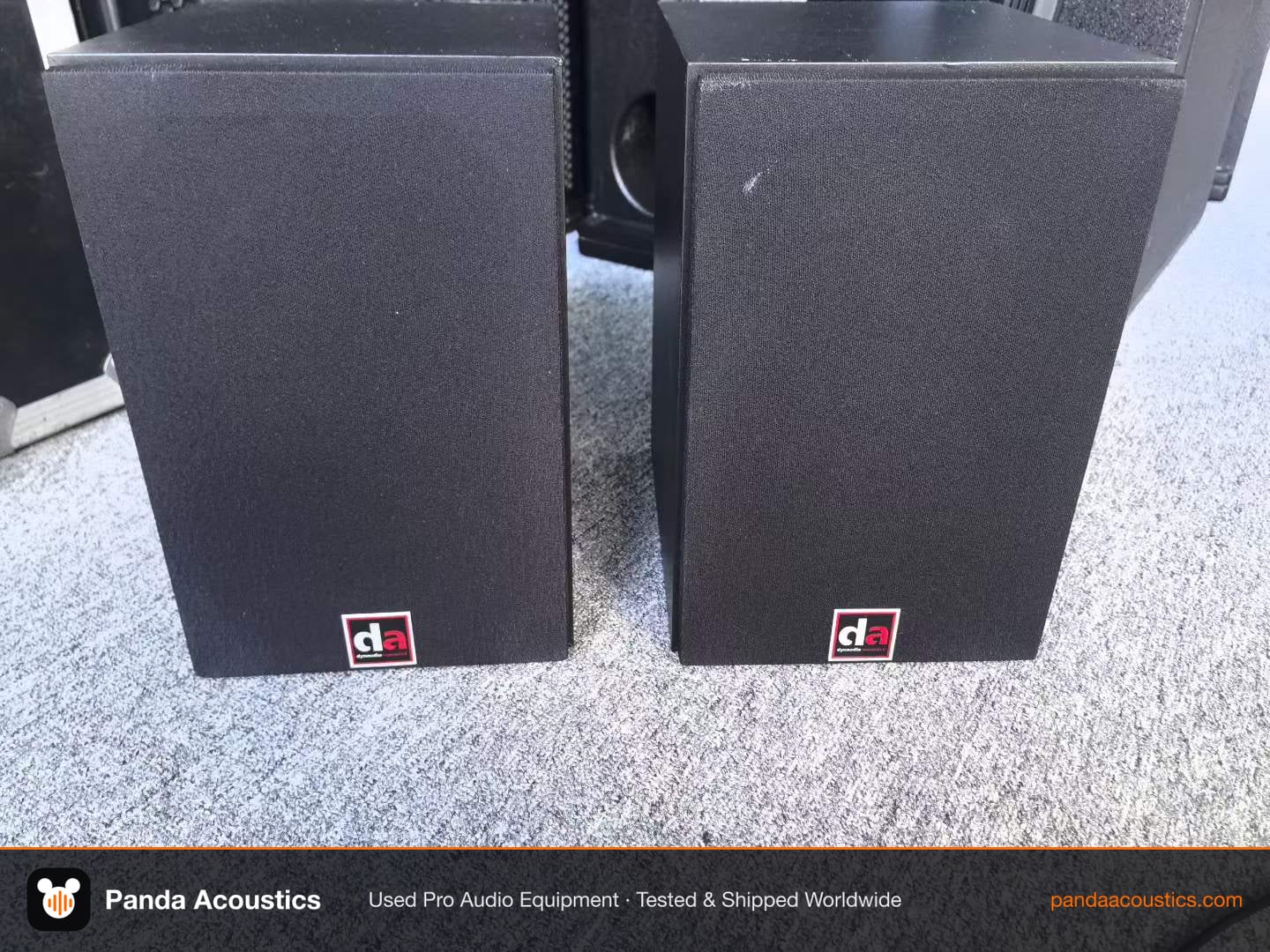
The Dynaudio Acoustics BM5 is a two-way passive studio monitor sold as a pair, rated at 4 ohms nominal impedance and 50–100 RMS watts of amplifier power, made in Denmark. It is worth buying used from China only if you need a compact nearfield monitor for studio, booth or low-level playback work and can match it to a stable 4-ohm amplifier; it is the wrong choice as a main KTV or rental PA speaker.
Key takeaways
- The BM5 is a passive two-way monitor pair rated 4 ohms nominal impedance and 50–100 RMS watts amplifier power, made in Denmark.
- Our listed unit is Grade A condition and in stock, with serial number 849635 recorded on the listing.
- Published price is not disclosed on the listing; the site-wide speaker price band is USD 200–1,500 per unit.
- Grade A and our inspection standard are defined on separate policy pages, so read those before you treat "Grade A" as a warranty.
- The BM5 is a nearfield monitor, not a high-output PA box; do not plan a KTV room or rental fleet around it.
The decision
You are a KTV operator, rental house, bar or club buying in volume from a China-based supplier, and you have found the Dynaudio Acoustics BM5 in a used-equipment catalogue. The question is not whether the BM5 is a good speaker in the abstract. The question is whether a small passive 4-ohm nearfield monitor belongs in your system at all, and if it does, what evidence you need before money leaves your account.
That decision has two parts. First, fit: does a compact nearfield monitor solve a real problem in your rooms, booths or control positions? Second, condition: is the specific pair you are being offered actually in the condition described, and can you verify it remotely? Both parts have to be answered before you commit to a bulk order.
What the data says
The listing facts are short and specific. The BM5 is a two-way studio monitor sold as a pair. Nominal impedance is 4 ohms. Amplifier power range is 50–100 RMS watts. Serial number 849635 is recorded. Country of manufacture is Denmark. Condition is Grade A and stock status is in stock. Price is not published.
The site-wide price band for the speaker category is USD 200 to USD 1,500 per unit. That band is a category range, not a BM5 quote, so treat it as a planning bracket only. Any actual BM5 price has to come from a direct quotation.
For comparison inside the same catalogue, the other listed speakers are different tools. The JBL CMX6403 is a column array rated 8 ohms. The JBL KP4010 is a two-way loudspeaker rated 8 ohms, part of the KP4000 series, with 2x speakON IN/THRU connectors, made in China. The DAS RF-15.85 is a two-way full-range speaker pair rated 400 W RMS at 8 ohms, 50 Hz–20 kHz, made in Spain, with 2x Speakon input and linked connectors. The RCF ART 310A is an active two-way speaker pair using an ND1411-M compression driver. The Barefoot Sound MicroMain27 is an active studio monitor pair, hand crafted in the USA, with XLR inputs and a volume control.
Two data points matter most for the BM5 buyer. First, 4 ohms versus the 8 ohms on the JBL and DAS boxes: your amplifier plan changes. Second, passive versus active: the BM5 needs an external amplifier, while the RCF ART 310A and Barefoot MicroMain27 are self-powered. That is a system-design difference, not a quality difference.
What the datasheet/docs don't tell you
The listing does not disclose frequency response, sensitivity, maximum SPL, crossover point, cabinet dimensions, weight, or driver part numbers. Those are Unknown from the materials available. That matters because without sensitivity and maximum SPL you cannot estimate whether a BM5 pair will cover a given room at the level your clients expect. You would be guessing.
Price is Not disclosed per unit on the listing. Lead time, minimum order quantity, warranty period and any certification are also Not disclosed in the materials. Do not assume CE, RoHS, UL, FCC or ISO status for this unit; none of that appears in the materials, so it is unverified.
Grade A is a defined condition tier on our grading page, but grading describes cosmetic and functional condition categories, not a performance guarantee for your specific application. Read the grading standard and the inspection standard together, and ask which checks were actually performed on serial 849635. The listing records the serial number, which is useful for matching the unit you receive to the unit you were quoted.
Finally, the materials do not state the history of this pair: previous install type, hours of use, whether drivers were ever reconed or replaced. That is Unknown. For a passive monitor, driver originality and voice-coil condition are exactly what you would want to confirm, so build that into your verification step rather than assuming it.
Who should not choose this
Do not buy the BM5 as the main playback speaker for KTV rooms. A 4-ohm passive nearfield monitor rated for 50–100 RMS watts is not a high-output room system, and the materials give no SPL figure to suggest otherwise. If your rooms need to fill with vocal-forward playback at party level, this is the wrong box.
Do not buy it for a rental fleet that gets moved, stacked and pushed hard. The materials describe a studio monitor pair, not a road box, and no rigging, flying or handling hardware is listed. Rental houses should look at the DAS RF-15.85 or JBL KP4010 listings instead, both of which are 8-ohm two-way speakers with Speakon connectivity.
Do not buy it if you cannot supply a 4-ohm-stable amplifier. Buyers who only own 8-ohm-oriented amp racks will either need different amplification or should skip this model. And do not buy it if you need a self-powered box; the RCF ART 310A and Barefoot MicroMain27 are the active options in this catalogue.
Comparison and trade-offs
Against the JBL KP4010: the KP4010 is an 8-ohm two-way loudspeaker with 2x speakON IN/THRU, made in China. It is the more natural fit for installed vocal playback where you want standard 8-ohm loading and Speakon cabling. The BM5 trades that convenience for a compact monitor form factor and 4-ohm loading.
Against the DAS RF-15.85: the DAS pair is rated 400 W RMS at 8 ohms across 50 Hz–20 kHz with a 15-inch low-frequency driver and Speakon input plus linked output, made in Spain. If output and low-end extension are the priority, the DAS is the stronger match on paper. The BM5's advantage is size and nearfield intent, not power.
Against the RCF ART 310A: the RCF is an active two-way pair, so it removes the amplifier decision entirely. The BM5 keeps the amplifier outside the box, which can be an advantage if you already own suitable amps and want one less thing to fail inside the cabinet, and a disadvantage if you do not.
Against the Barefoot Sound MicroMain27: the Barefoot is an active studio monitor pair, hand crafted in the USA, with XLR inputs and a volume control. Both are studio-oriented, but the Barefoot is self-powered and the BM5 is passive at 4 ohms. Choose based on whether you want to buy amplification separately.
Against the JBL CMX6403: the CMX6403 is an 8-ohm column array, a different coverage pattern entirely. It is not a substitute for a nearfield monitor, and the BM5 is not a substitute for a column array in a reverberant room.
Implementation / next step
Before paying, request a written quotation for the BM5 pair that states the unit price, quantity available, and lead time, and ask for the inspection record tied to serial number 849635. Read the condition grading standard and the inspection standard first so you know what those records should contain, then confirm amplifier compatibility at 4 ohms with your own amp inventory. Review payment terms and shipping and logistics so the landed cost is clear before you commit.
Concrete next step: open the Dynaudio Acoustics BM5 listing, send your room or application details plus your amplifier model, and ask for a quotation with the inspection record for serial 849635 attached.