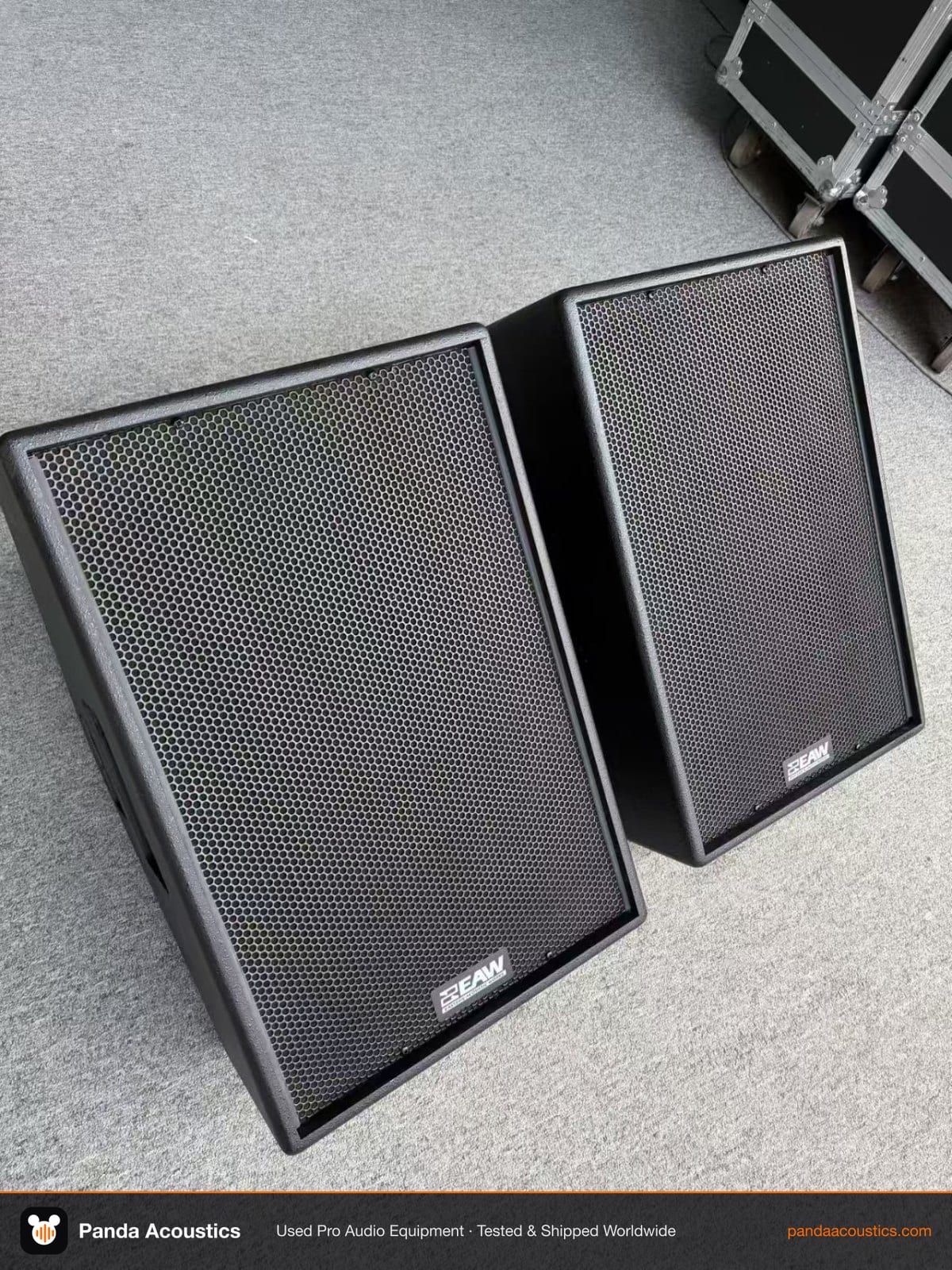
A used EAW SM129zi is a stage monitor speaker sold in pairs at Condition A, and the published listing confirms only a narrow set of facts: two Speakon NL4 connectors, PIN 1+/- signal with PIN 2+/- not connected, a recorded serial number, design origin in Whitinsville, MA, and manufacture in China. Everything else—driver condition, acoustic output, dispersion, and history—is not disclosed and must be verified before payment.
Quick answer
The SM129zi is worth considering for bulk buyers who can verify condition on the ground and who treat the listing as a starting document, not a specification sheet. If you need published acoustic data before you commit budget, this model will not give it to you, and you should look at a listing that publishes more.
Key takeaways
- The listing states Condition A and in-stock status for the SM129zi, sold as a pair per the product name.
- Connector data is specific: 2x Speakon NL4, PIN 1+/- signal, PIN 2+/- NC. That pinout matters when you plan amp racks and cable looms.
- A serial number is recorded (000892390AKDD0021), which is the single most useful anti-swap check on a used unit.
- Design origin is Whitinsville, MA; manufacture is China. Those are two different facts and should not be merged in your purchasing notes.
- Price is not published for this model. The only price figure in our materials is a category range of USD 200 to USD 1,500 per unit.
The decision
You are a KTV operator, touring sound company, rental house, or bar and club buyer working in Russia, the Middle East, South America or Africa. You are buying volume, not one unit, and you are weighing a used EAW monitor against other used speaker stock. Your real question is not "does this model exist" but "can I confirm the condition of the units I will actually receive, and does the landed cost still work after freight, duties and any re-coning?"
The SM129zi answer depends on your inspection access. If you or your agent can check the units against a written standard, the thin published data is manageable. If you are buying sight-unseen on the strength of a listing alone, the missing data becomes your risk.
What the data says
Only these facts are published for the SM129zi:
- Connectors: 2x Speakon (NL4).
- Pin configuration: PIN 1+/- signal, PIN 2+/- NC.
- Serial number: 000892390AKDD0021.
- Design origin: Whitinsville, MA.
- Manufacture: China.
- Condition: A. Stock status: in stock.
- Product name: EAW SM129zi Stage Monitor Speaker (Pair).
Price for the SM129zi is not published. The only pricing figure available is the speaker category range of USD 200 to USD 1,500 per unit. Treat that as a planning band, not a quote. Any landed-cost calculation you build must use a confirmed quote, because freight, duty and inspection costs are not in these materials.
For context on how other used speaker stock is documented, the speaker category page shows the same pattern: condition grade, stock status, and a short spec block rather than a full acoustic datasheet.
What the datasheet/docs don't tell you
This is the part that decides the purchase. The following are Unknown or Not disclosed for the SM129zi:
- Maximum SPL, sensitivity, and power handling: Not disclosed. You cannot size amplifier channels from the listing.
- Dispersion pattern and coverage angle: Not disclosed. You cannot plan monitor placement or stage coverage from the listing.
- Driver condition, cone and diaphragm state, and whether any driver has been replaced: Not disclosed. This is the largest single risk on a used monitor.
- Cabinet condition beyond the Condition A grade: Not disclosed in detail. Read the condition grading standard to see what Grade A does and does not cover.
- Age, service history, and prior use environment: Not disclosed.
- Warranty period, MOQ, and lead time: Not disclosed in these materials.
- Certification status: Not disclosed. Do not assume any certification.
Why it matters: a stage monitor is a working tool that gets dropped, overdriven and re-coned. The listing tells you the connector standard and the serial number, which is enough to identify the unit and plan cabling. It does not tell you whether the unit will survive a touring season. That gap is closed by inspection, not by reading.
Who should not choose this
Do not choose the SM129zi if you need published acoustic specifications to complete a system design before you release budget. Without SPL, sensitivity and dispersion, you cannot model coverage or match amplifiers on paper, and you will be guessing.
Do not choose it if you cannot inspect the units or appoint an inspector. The published data will not protect you on driver condition, and a used monitor with a tired driver is a re-cone cost you did not budget.
Do not choose it if you need a documented warranty period or certification before import. Neither is disclosed here, so a procurement process that requires them will stall.
Comparison and trade-offs
Staying strictly within published facts, here is how the SM129zi sits against other in-stock speaker listings in the same catalogue.
- Against the Vieta VT-12: the VT-12 publishes RMS power at 250W, 8Ω impedance, and 2x Speakon IN/OUT, and is made in the EC. The SM129zi publishes no power or impedance figure. If you need to match amplifier output on paper, the VT-12 gives you more to work with.
- Against the JBL CMX6403: the CMX6403 publishes 8Ω impedance. Again, the SM129zi publishes no impedance value, so cable and amp planning for the SM129zi depends on confirming the unit.
- Against the Meyer Sound HD-1: the HD-1 publishes voltage ranges (90-130 V / 200-250 V) and fuse ratings, which is useful for export power planning. The SM129zi publishes no voltage or fuse data.
- Against the Barefoot Sound MicroMain27: the MicroMain27 is an active monitor with XLR inputs and a volume control, and its condition is described as Grade A with minor dust and light handling wear. The SM129zi listing describes condition only as Grade A.
The trade-off is consistent: the SM129zi gives you connector and identity data, while other listings give you electrical or acoustic data. Choose based on which gap your project can absorb. A rental house with in-house bench staff can absorb missing acoustic data. A buyer assembling a system remotely cannot.
Implementation / next step
Before paying, do this in order. First, request the inspection record for the specific serial numbers you will receive and check it against the inspection standard. Second, confirm the pin configuration on the actual units matches PIN 1+/- signal and PIN 2+/- NC, because a modified cabinet will change your cable plan. Third, confirm the quantity available and the per-unit price in writing, since the SM129zi price is not published. Fourth, get freight and duty quoted to your destination port so your landed cost is real. Fifth, review payment terms and shipping and logistics before releasing funds.
Concrete next step: open the EAW SM129zi listing, note the serial number shown, and send a request for the inspection record and a written per-unit quote for the quantity you need.