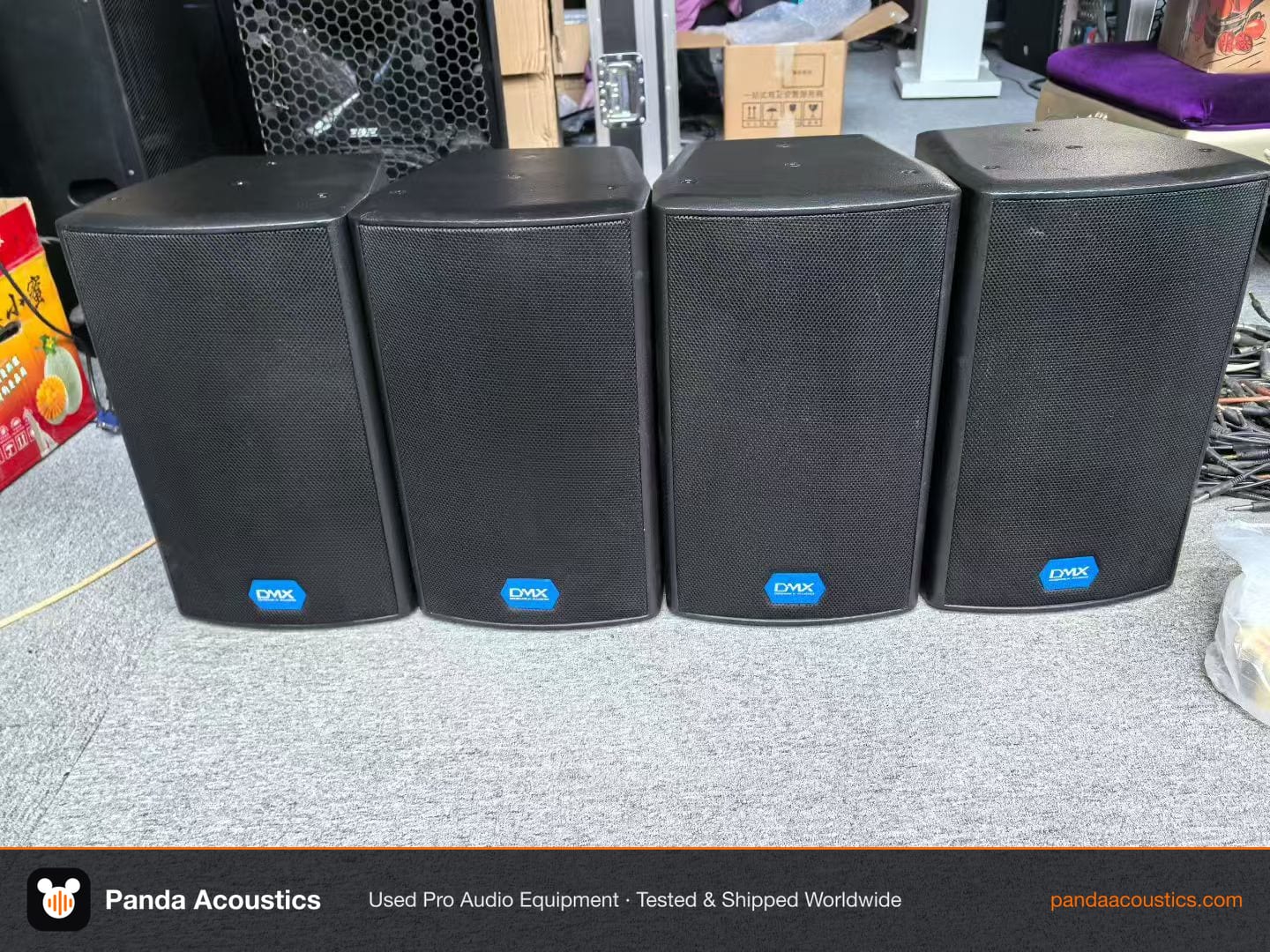
The DMX ES-10 is a two-way full-range passive speaker rated at 200W into 8Ω with a published frequency response of 58Hz–18kHz, and used units in Condition A are listed as in stock. Whether it is worth buying in volume depends less on that headline spec than on whether the individual drivers inside each cabinet match the published part numbers before you pay.
Quick answer
For bulk buyers, the ES-10 sits in a price band of USD 200–1500 per unit, and it is a credible used purchase for KTV rooms, bars and small rental inventory where a 200W, 8Ω passive box with speakON inputs is enough. The catch is that the published spec sheet describes the model, not the specific cabinets you will receive, so driver part numbers and condition grade have to be confirmed in writing before payment.
Key takeaways
- The ES-10 is a passive two-way full-range speaker: 200W, 8Ω, 58Hz–18kHz, with 2 x speakON input connectors.
- The published driver lineup is a CD-44-40 compression driver (40W, 8Ω) and an MBE10-200 woofer (200W, 8Ω) — these part numbers are the core of your verification.
- Used units are listed in Condition A and in stock, but the listing does not publish a unit price, so landed cost has to be quoted per order.
- Budget context for this category is USD 200–1500 per unit; the ES-10's position inside that band is not disclosed.
- Nothing in the materials confirms certification, warranty, MOQ or lead time — treat all four as Unknown until quoted.
The decision
You are furnishing or refreshing a fixed installation — a KTV floor, a bar, a small club — or adding a batch of utility boxes to a rental fleet. You are buying from China in volume, so the unit price matters less than the cost of the boxes that arrive dead, mismatched or with the wrong drivers. The decision in front of you is not "is the ES-10 a good speaker" but "can I confirm that the ES-10s I receive are the ES-10s described, at a landed cost that beats local supply."
That reframes the purchase. A 200W, 8Ω passive box is easy to specify and easy to substitute. The risk is substitution: a cabinet that looks like an ES-10 but carries a different woofer or compression driver will behave differently on the same amplifier channel and will not take the same replacement parts. Your job before paying is to close that gap.
What the data says
The published specification for the DMX ES-10 is short and specific, which is useful. It is a two-way full-range speaker with a frequency response of 58Hz–18kHz, 200W power handling and 8Ω impedance. Input is via 2 x speakON connectors. Internally, the model is documented with a CD-44-40 compression driver rated 40W at 8Ω and an MBE10-200 woofer rated 200W at 8Ω.
Those driver figures are the most valuable numbers on the page. The 40W compression driver and the 200W woofer tell you what the crossover is likely designed around and what replacement parts you would need to stock. For a rental house or a KTV operator running many rooms, spare drivers are a real line item, and knowing the exact part numbers before you buy lets you price that in.
Condition is listed as A, and stock status is in stock. The condition grading standard defines what grade A means in this supplier's terms, and the inspection standard defines what gets checked. Read both before you accept a grade A claim at face value — the grade is only as good as the inspection behind it.
What the materials do not give you is a unit price for the ES-10. The only price figure available is the category band of USD 200–1500 per unit, which is wide enough to cover very different products. Treat that band as a sanity check, not a quote.
What the datasheet/docs don't tell you
Several things that matter for a bulk decision are simply not in the materials, and each one changes the risk profile.
- Unit price: Not disclosed. The USD 200–1500 band is a category range, not the ES-10 price. You cannot compute landed cost without a quote.
- Maximum SPL and sensitivity: Unknown. The 200W rating and 58Hz–18kHz response do not tell you how loud the box plays or how much amplifier headroom it needs. For a club or a rental fleet this is a real gap.
- Dispersion pattern: Unknown. Without it you cannot plan coverage for a room or decide how many boxes a space needs.
- Driver originality per unit: Not verified in the listing. The spec names CD-44-40 and MBE10-200, but the listing does not confirm that each used cabinet carries those exact parts.
- Certification: Not stated. No CE, RoHS, UL or FCC claim appears in the materials, so do not assume any.
- Warranty, MOQ, lead time: Not disclosed. All three affect total cost and cash flow on a volume order.
- Grille, cabinet and connector condition: Unknown beyond the grade A label. speakON sockets wear, and a loose NL4 is a failure point in rental use.
Why this matters: the ES-10's published numbers are enough to decide whether the model fits your room or fleet on paper. They are not enough to decide whether a specific pallet of used cabinets is worth the money. That second decision lives entirely in the inspection and the quote.
Who should not choose this
Touring sound companies should not buy the ES-10 for main PA duty. A 200W, 8Ω two-way box with a 58Hz–18kHz response and no published SPL or dispersion figure is not a rider-friendly main system, and the brand will not satisfy a promoter or a visiting engineer. If your clients specify systems by name, this is not the box.
Buyers who cannot get driver part numbers and a condition grade confirmed in writing before payment should also walk away. The whole value case for used gear rests on knowing what is inside the cabinet. If the supplier will not put CD-44-40 and MBE10-200 on the paperwork, you are buying a lookalike, not a known quantity.
Finally, anyone who needs a certified product for a regulated venue should not proceed. No certification appears in the materials, so if your project requires documented compliance, this is the wrong category of purchase until that is resolved.
Comparison and trade-offs
Within the same supplier's used speaker stock, the ES-10 is the only model in the materials with a fully published driver breakdown. That is its main advantage over the alternatives listed alongside it, whose listings give connector and origin details but not driver part numbers.
Against the Vieta VT-12, the trade-off is power and impedance. The VT-12 is listed at 250W RMS into 8Ω with 2 x speakON in/out and is made in the EC. The ES-10 is 200W at 8Ω with 2 x speakON. If you need slightly more power handling per box and European manufacture, the VT-12 is the closer fit; if you want a documented driver bill of materials, the ES-10 is stronger.
Against the JBL CMX6403 column array, the comparison is form factor, not power. The CMX6403 is an 8Ω column array, which suits different room geometry than a point-source two-way box. The materials do not publish enough CMX6403 data to compare output or coverage, so treat this as a fit question rather than a spec contest.
The EAW SM129zi is a stage monitor in pairs, and the Meyer Sound HD-1 is a powered high-definition monitor with a published voltage range of 90–130V / 200–250V. Neither is a like-for-like swap for a passive full-range install box. The ES-10's role is utility fill and fixed install, and that is where it should be judged. Browse the full speaker category page to see how these sit side by side.
Implementation / next step
Before paying, request a written confirmation per cabinet that the compression driver is CD-44-40 (40W, 8Ω) and the woofer is MBE10-200 (200W, 8Ω), together with the condition grade and the inspection scope applied. Ask for the unit price against the USD 200–1500 category band, and ask explicitly about warranty, MOQ and lead time, since none are disclosed. Then read the shipping and logistics page to model landed cost, and the payment terms page before you commit volume.
The concrete next step: open the DMX ES-10 listing and send the driver part numbers from that page back to the supplier as a written confirmation request. If the reply matches the published spec, you have a buyable lot. If it does not, you have saved yourself a container of mismatched boxes.