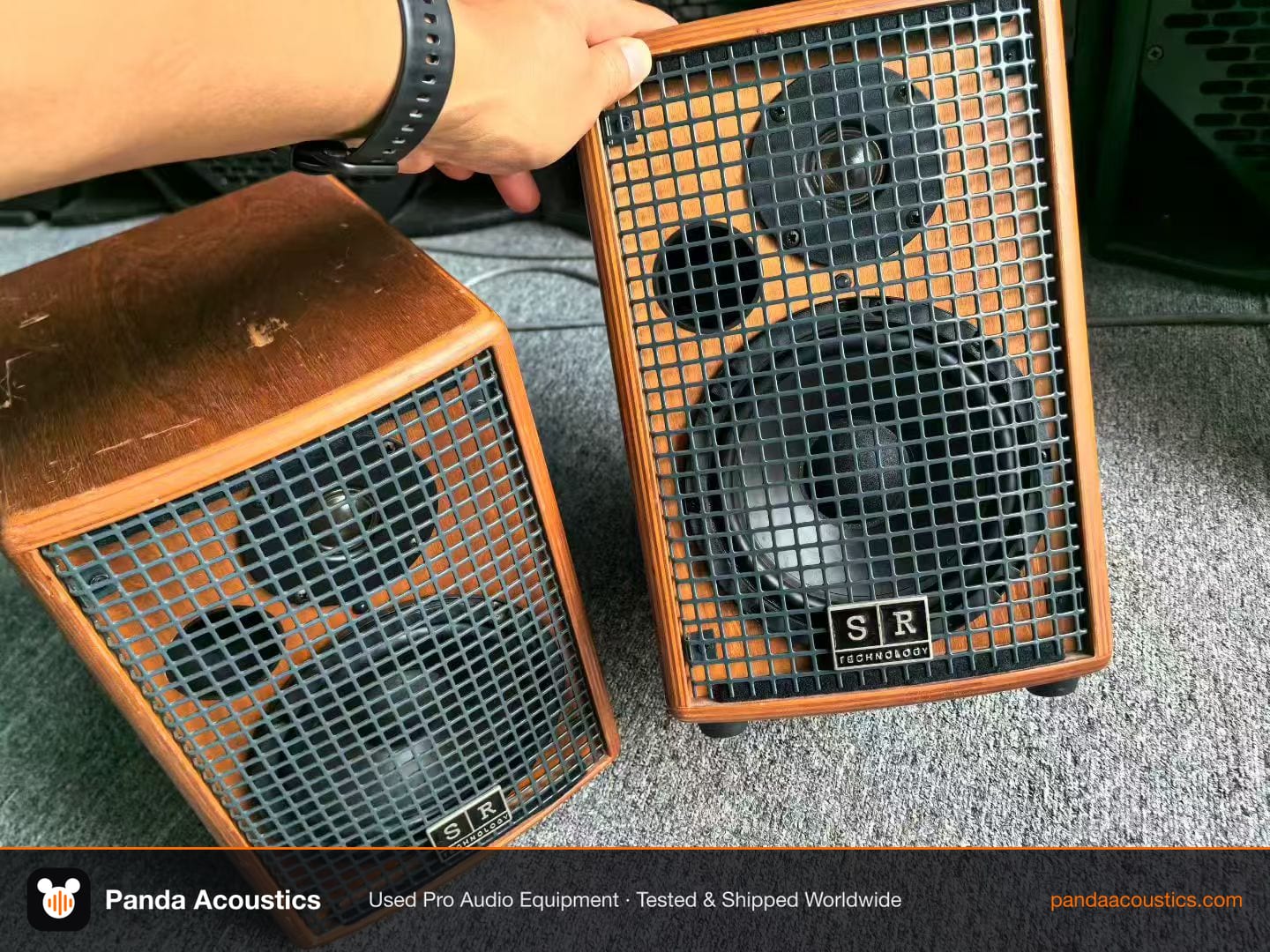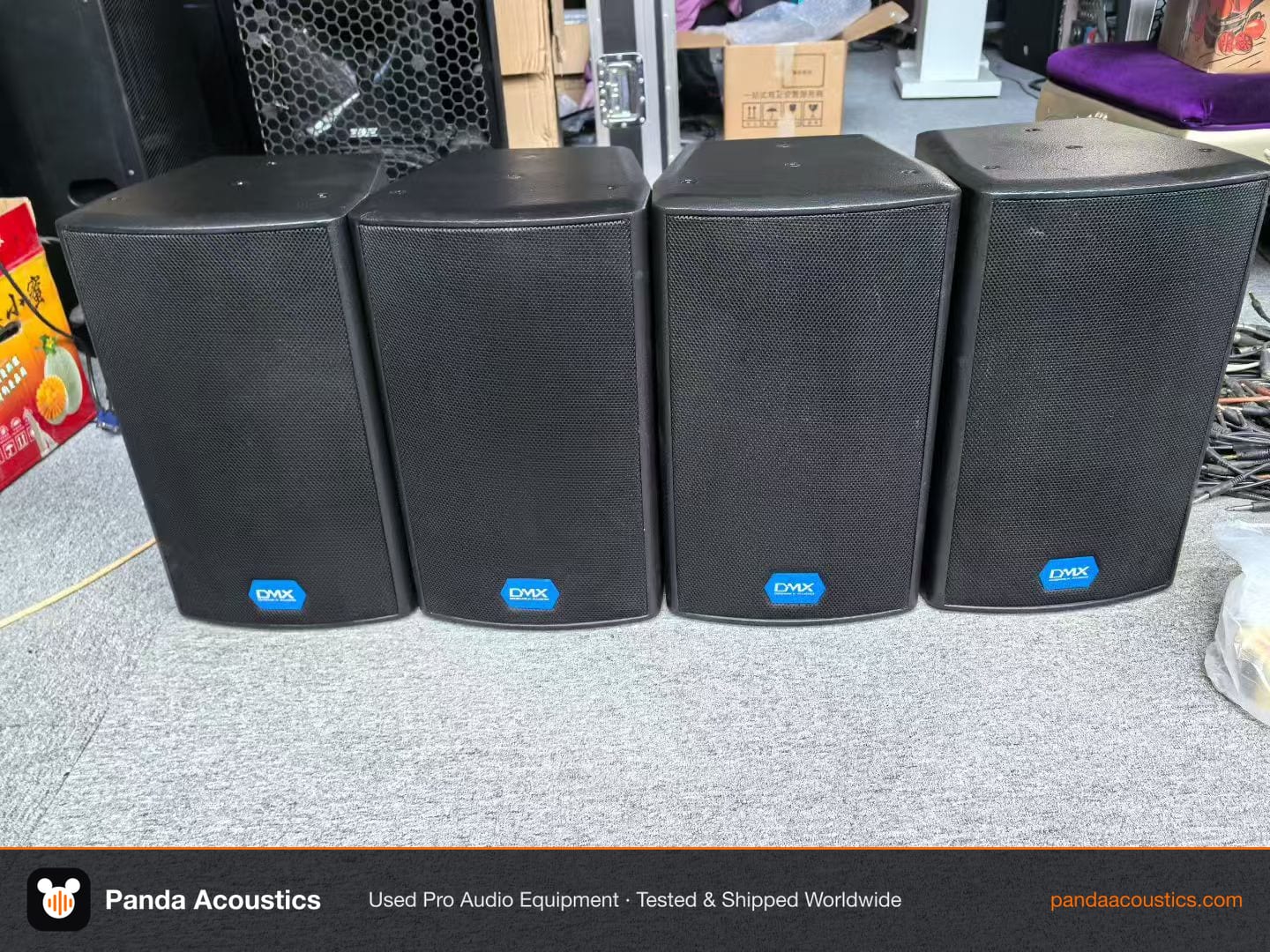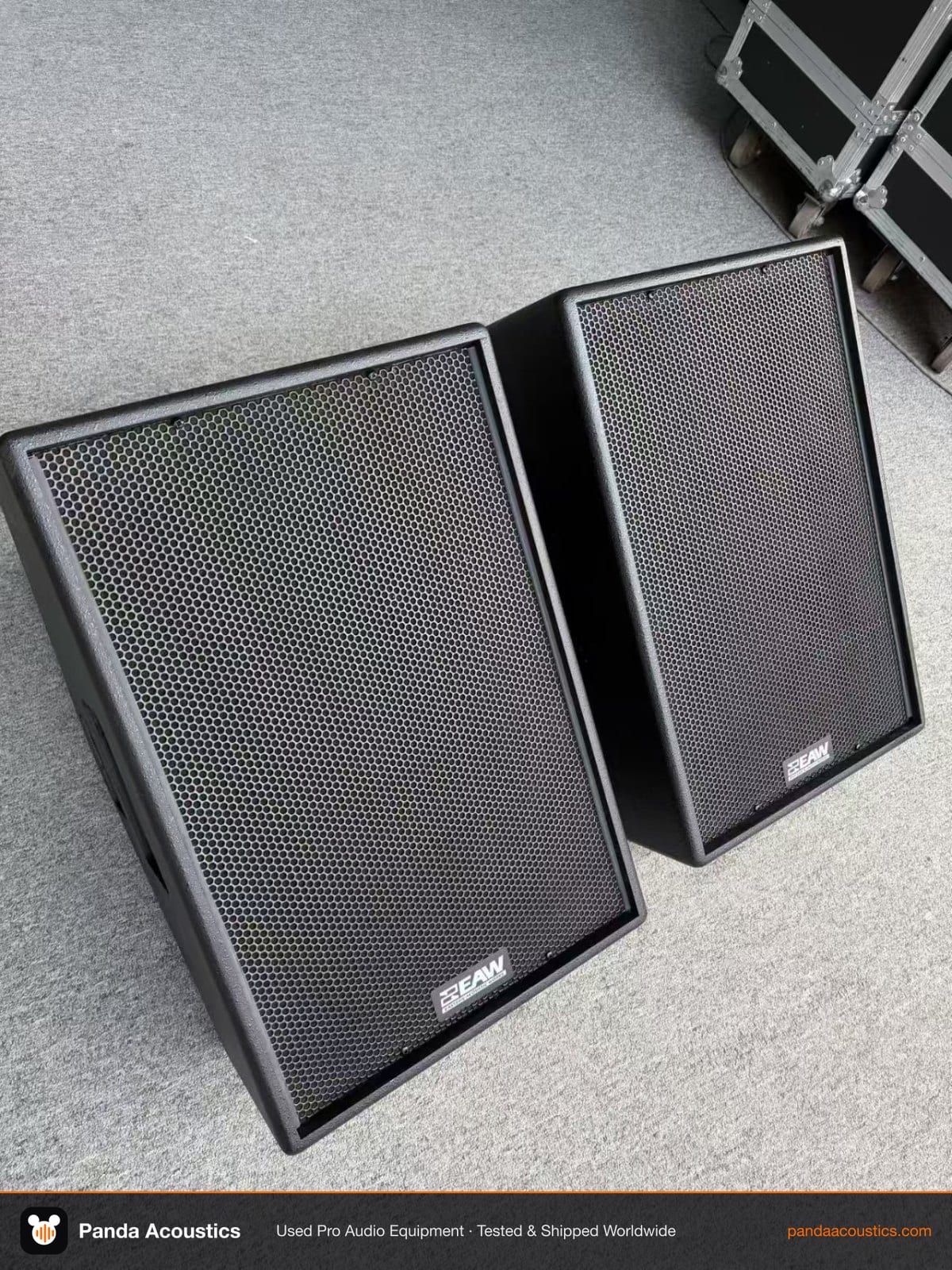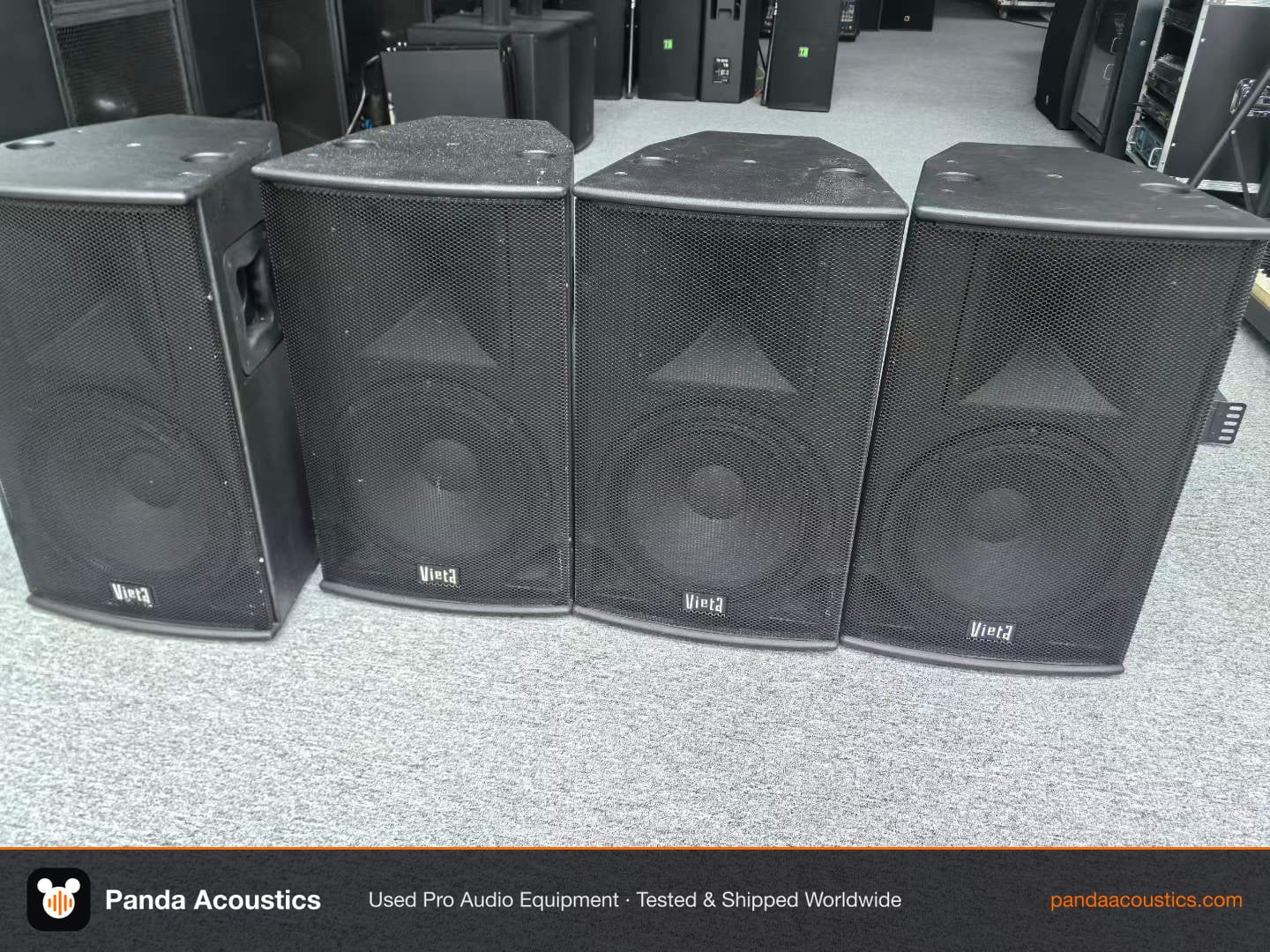
A 100-seat bar is a small-to-mid room, so you do not need a line array. A practical used approach is a handful of full-range two-way boxes — for example the Vieta VT-12 at 250W RMS and 8Ω, or the RCF ART 310A active pair — plus verification of impedance, power handling, voltage and physical condition before payment. Used equipment from China is worth buying only when the grading, inspection record and shipping terms are confirmed in writing first.
Quick answer
For a 100-seat bar, plan around full-range two-way speakers rather than a line array, and match the count to how loud and how distributed the room needs to be. Buy used only if you can confirm condition grade, serial numbers, voltage configuration and connector type before paying, because those are the facts that decide whether the boxes work in your room and on your mains.
Key takeaways
- The Vieta VT-12 is a two-way full-range box rated 250W RMS at 8Ω with 2x Speakon IN/OUT — a passive box that needs an amplifier you supply.
- The RCF ART 310A is an active two-way pair, so it carries its own amplification and avoids a separate amp match.
- The Meyer Sound HD-1 is a high-definition monitor with switchable 90-130 V / 200-250 V voltage and XLR input — check which voltage setting your units ship at.
- Published per-unit pricing across this category runs from 200 to 1500 USD; individual listings show price as not published.
- Grade A is the stated condition for every in-stock model listed here, but grade alone does not tell you amplifier pairing or coverage.
The decision
You run or supply a bar of roughly 100 seats — a room where people sit close to the stage or DJ booth, talk over the music, and expect vocals to stay intelligible at moderate levels. You are buying in volume, possibly for more than one venue, and you are weighing used professional equipment from China against new gear at local prices. The real question is not "which speaker is best" but "which used boxes can I verify, land affordably, and power correctly in my room."
That decision splits into three checks: does the box type suit a small room, does the electrical spec match what you can supply, and can you prove condition before money leaves your account. Everything below is organized around those three.
What the data says
The materials list six in-stock speaker models, all Grade A. Their published facts differ in ways that matter for a bar:
- Vieta VT-12 — two-way full-range, 250W RMS, 8Ω, VT-series, 2x Speakon (IN/OUT), crossover inductors GDSL1017 1.4mH/5A and GDSL1006 0.5mH/5A, made in EC. Passive, so it needs an external amplifier.
- RCF ART 310A — active two-way speaker pair, with compression driver ND1411-M ART 310A and crossover capacitors ROYAL403 20W 6.25J and ROYAL573 20W 2.5J.
- Meyer Sound HD-1 — high-definition audio monitor pair, serial 07342740, voltage 90-130 V / 200-250 V, fuse 5 A / 3.15 A, XLR input.
- JBL CMX6403 — column array speaker, 8 ohms.
- dynaudioacoustics BM5 — two-way studio monitor pair, 4 ohms nominal, amplifier power 50-100 RMS watts, serial 849635, made in Denmark.
- Barefoot Sound MicroMain27 — active studio monitor pair, hand crafted in the USA, XLR inputs, volume control, Grade A with minor dust and light handling wear.
Category pricing runs from 200 to 1500 USD per unit. No individual listing publishes a price, so per-model cost is Not disclosed until you request it.
What the datasheet/docs don't tell you
Several facts that decide whether these boxes work in a 100-seat bar are simply not in the listing data, and you should treat them as open questions rather than assumptions:
- Coverage and SPL for your room — Unknown. No dispersion angles or maximum SPL figures are published, so how many boxes cover 100 seats is Not disclosed.
- Amplifier pairing for the passive VT-12 — Not disclosed. The box is 250W RMS at 8Ω, but the recommended amplifier model and DSP settings are not stated.
- Warranty — Not disclosed. No warranty period appears in the materials for any model.
- Certification — Not applicable to what is published. No CE, RoHS, UL or FCC marks are stated, so do not assume them.
- Lead time and MOQ — Not disclosed. Neither appears in the materials.
- Voltage as shipped — the HD-1 supports 90-130 V and 200-250 V, but which setting each unit is configured to is Not disclosed per unit.
Why this matters: a bar buyer who assumes coverage, amp pairing or certification without confirming it can end up with boxes that under-cover the room, clip on the wrong amp, or fail a local electrical inspection. Those are the gaps to close before paying, not after.
Who should not choose this
Do not buy used for this project if you need a certified, warrantied, plug-and-play install with a coverage prediction signed off by an acoustician. No certification or warranty period is published here, and coverage data is Unknown, so a venue that must satisfy an inspector or a landlord's insurer should buy new with documentation.
Also skip this route if you cannot inspect or have units verified before payment, or if you cannot supply the external amplification a passive box like the VT-12 requires. A buyer who wants one box that powers itself should look at the active options instead of a passive model plus amp.
Comparison and trade-offs
Within the listed stock, the trade-off is mostly active versus passive and installed versus studio:
- Passive vs active: the Vieta VT-12 (250W RMS, 8Ω, Speakon) needs an amplifier you supply; the RCF ART 310A pair is active and carries its own amplification. Active removes the amp-match unknown but adds a mains and self-powered failure point.
- Full-range vs column: the JBL CMX6403 is a column array at 8 ohms — a different coverage shape than a point-source two-way, useful where you want narrower vertical spread, but its other specs are Not disclosed here.
- Install vs studio: the Meyer Sound HD-1, dynaudioacoustics BM5 and Barefoot Sound MicroMain27 are monitors built for close listening, not for filling a bar. The BM5 is 4Ω at 50-100W RMS, and the MicroMain27 is an active pair — both are better suited to a control room than a 100-seat floor.
There is no single winner. Pick passive full-range if you already own suitable amps; pick active if you want to avoid amp matching; avoid studio monitors for the main bar system.
Implementation / next step
Before paying, do four things in order. First, request the per-unit price and confirm it sits inside the 200-1500 USD category range. Second, ask for the inspection record and grade confirmation against the condition grading standard and the inspection standard. Third, confirm voltage configuration, connector type and, for the VT-12, the amplifier you will pair it with. Fourth, get landed cost and terms in writing via the shipping and logistics and payment terms pages.
Then browse the speaker category page and shortlist the models that match your amp situation. The concrete next step: send your room size, seat count and amplifier inventory to Panda Acoustics and request a written quote with condition grade and voltage confirmed for each unit.