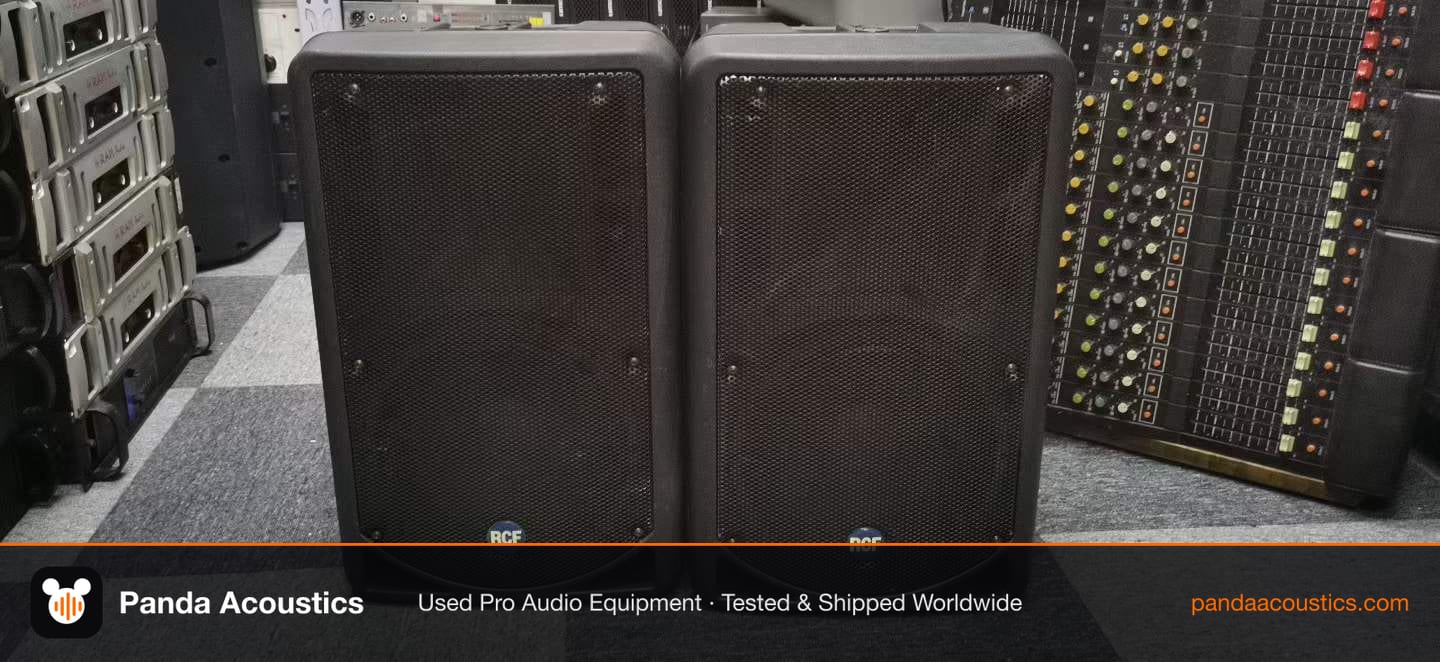
The RCF ART 310A is an active two-way speaker that shows up used in pairs, and it is worth buying in bulk from China only when the seller can name the compression driver and the crossover capacitors inside the box. On Panda Acoustics the listing is graded Condition A and marked in stock, with the driver identified as ND1411-M ART 310A and two ROYAL crossover capacitors specified. Price is not published, so your cost sits somewhere inside the USD 200-1500 per unit band until you request a quote.
Quick answer
Yes, a used RCF ART 310A pair is a reasonable bulk purchase for KTV rooms, rental stock and small clubs, provided the seller documents the internal parts rather than just the cabinet. The parts that matter are the ND1411-M compression driver and the ROYAL403 20W 6.25J and ROYAL573 20W 2.5J crossover capacitors, because those are the components that decide whether the box still sounds like an ART 310A. If a seller cannot confirm those, treat the offer as an unbranded active box and price it that way.
Key takeaways
- The Panda Acoustics RCF ART 310A listing is Condition A, in stock, and sold as an active two-way speaker in pairs.
- Three internal parts are disclosed: the ND1411-M ART 310A compression driver and two ROYAL crossover capacitors rated 20W 6.25J and 20W 2.5J.
- Price is not published on the listing; the only figure available is the USD 200-1500 per unit range for this category.
- Condition grading and inspection are documented on separate policy pages, so you can read the standard before you ask for evidence.
- No warranty period, MOQ, lead time or certification appears in the materials, so none can be promised to you.
The decision
You are a KTV operator, rental house or club buyer in Russia, the Middle East, South America or Africa, and you are filling a room count rather than a single install. Active two-way boxes like the ART 310A are attractive because each cabinet carries its own amplification, so a failure takes out one position, not a whole amp rack. That logic only holds if the amplifier module and the driver in each cabinet are sound, which is exactly what a photo of a scuffed corner will not tell you.
The real decision is not "RCF or something else". It is whether you can get part-level evidence at volume, and whether the landed cost per unit still leaves margin after freight, duty and the spares you will keep on the shelf. Read the condition grading standard first, then decide what evidence you will accept.
What the data says
The materials give a narrow but useful set of facts. The RCF ART 310A is listed as an active two-way speaker, sold as a pair, Condition A, in stock, with price not published and currency in USD. Its disclosed specifications are the ND1411-M ART 310A compression driver and two ROYAL crossover capacitors: ROYAL403 20W 6.25J and ROYAL573 20W 2.5J.
The category price range is USD 200 to USD 1500 per unit. That is the only price figure available; the listing itself carries no number, so any quote you receive should be checked against that band. Everything else about the model, including power output, coverage angle, weight and amplifier module details, is not in the materials and is therefore Unknown here.
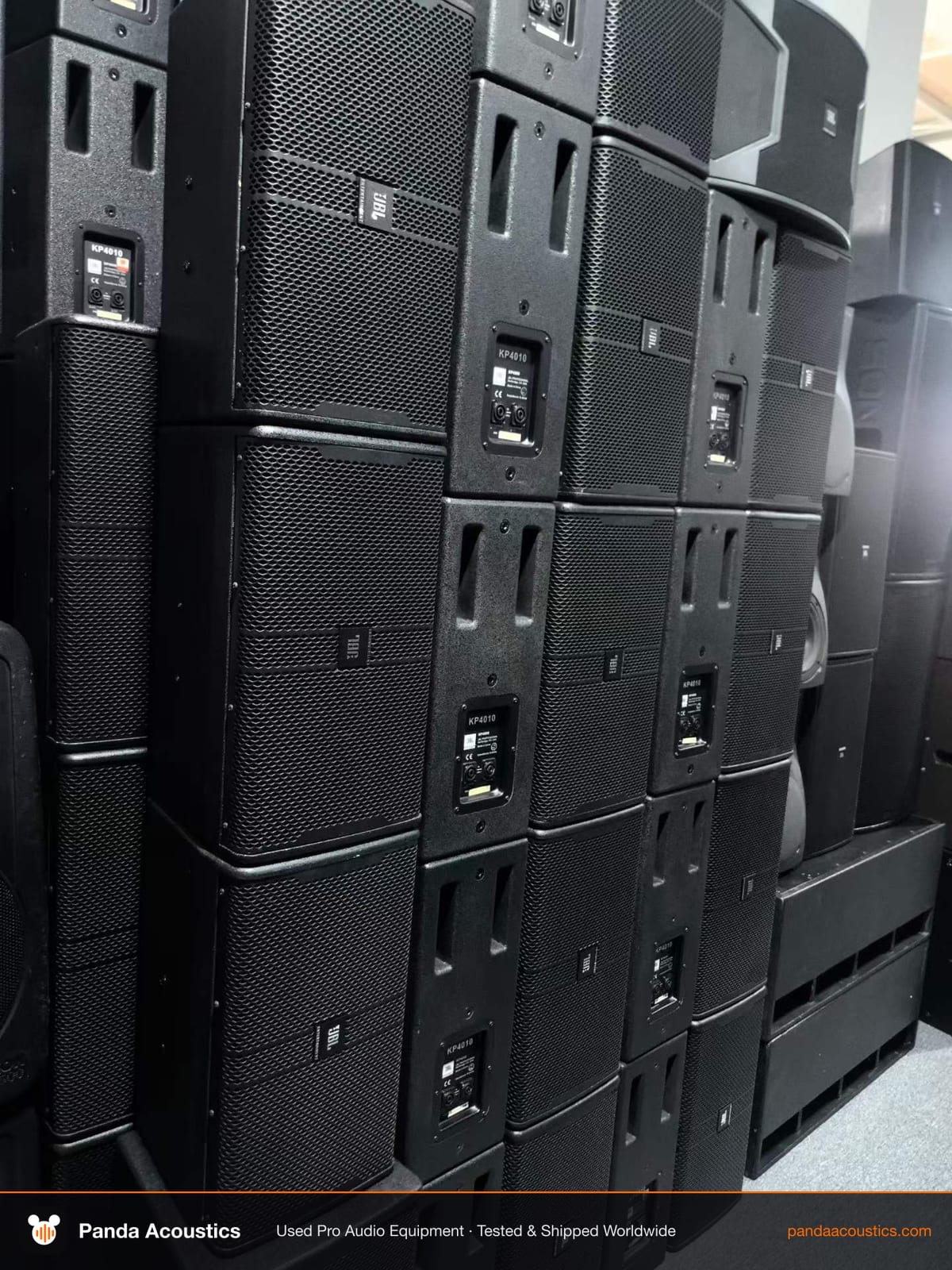
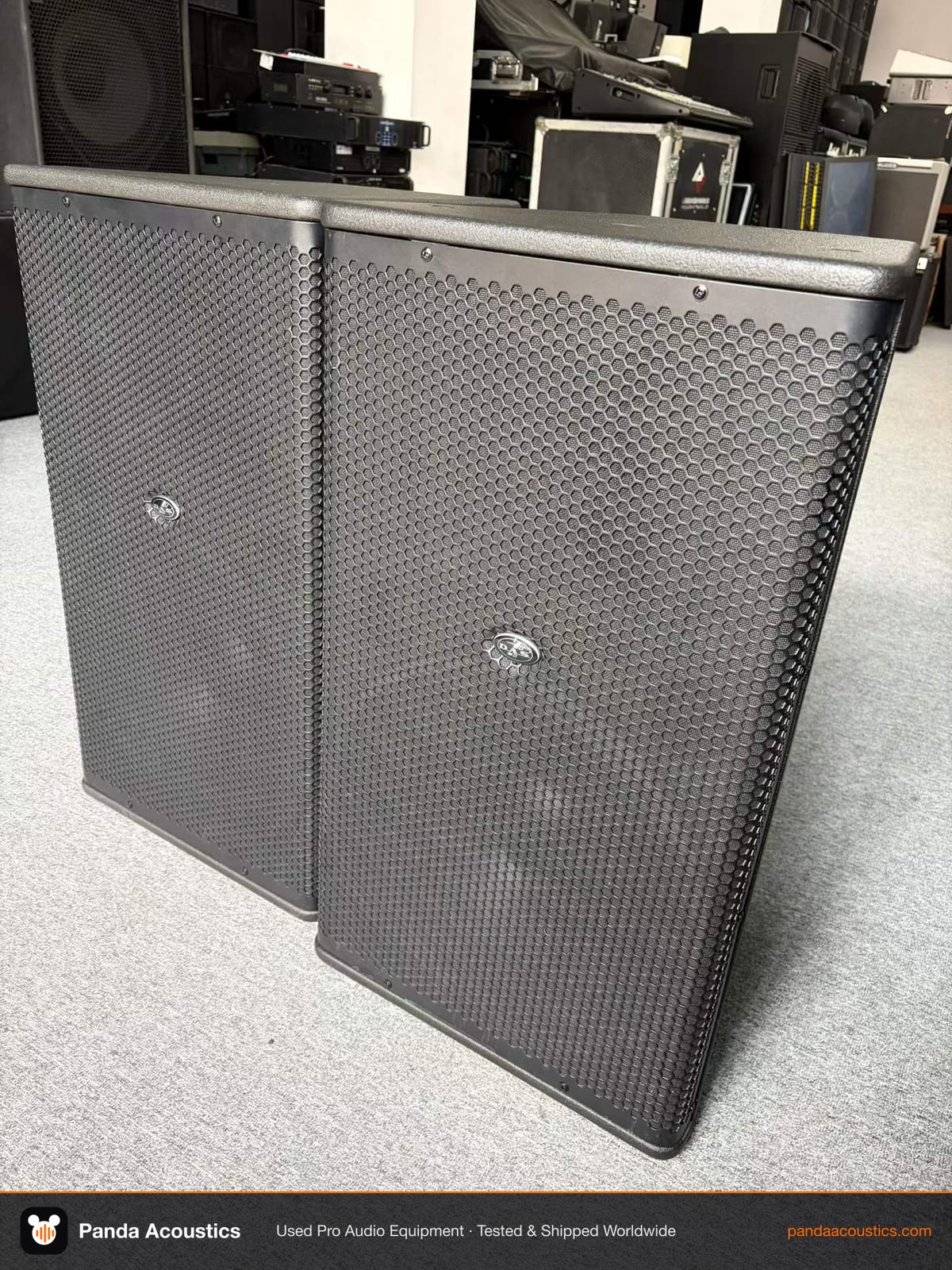
For comparison within the same catalogue, the JBL KP4010 is a passive two-way box at 8 ohms with 2x speakON IN/THRU connectors, made in China. The DAS RF-15.85 is a passive two-way full-range pair rated 400 W RMS at 8 ohms, 50 Hz to 20 kHz, with an M-30 HF driver and a 15P LF driver, made in Spain. The BOSE Panaray LT 9400 is passive, 8 ohms, 100 W power handling, NL4 connections. The faitalPRO 15-inch two-way lists 700 W bass power, 80 W high power, a 15FX560 woofer at 1400 W and 8 ohms, with 2x NL4 speakON inputs.
What the datasheet/docs don't tell you
Several things you would want before paying are simply not disclosed. The listing does not state the amplifier module model, its power rating, or whether the module is original. It does not state the woofer model, the cabinet dimensions, the weight, or the dispersion pattern. It does not state the age of the units, the hours on them, or whether the pair is matched by serial number.
Commercial terms are also absent. MOQ is Not disclosed. Lead time is Not disclosed. Warranty period is Not disclosed. Certification is Not disclosed, and no CE, RoHS, UL, FCC or ISO mark should be assumed from these materials. Payment and freight terms live on their own pages, so the total landed cost per unit is Unknown until you have a quote plus a shipping estimate.
Why this matters: the crossover capacitors and the compression driver are the two items the listing does name, which suggests they are the parts a buyer should ask about. A capacitor that has drifted and a driver that has been replaced with a non-original part both produce a box that looks fine and sounds wrong. Without a stated inspection result per unit, you are buying on the strength of the grading page, not on a measurement.
Who should not choose this
Do not choose this if you need a written warranty period, a certification file for a tender, or a guaranteed delivery date before you commit. None of those appear in the materials, and a supplier who invents them for you is telling you something about how the rest of the deal will go.
Also skip it if your rooms are already wired for passive boxes and a central amp rack. The ART 310A is active, so every position needs mains power at the cabinet; if your KTV rooms were built around passive 8-ohm speakers and speakON runs, the JBL KP4010 or the DAS RF-15.85 fits the existing infrastructure with less rework. Finally, if your budget per unit is at the bottom of the USD 200-1500 band, do not expect an active RCF pair to land there after freight; wait for a quote rather than assuming.
Comparison and trade-offs
Against the JBL KP4010, the trade-off is amplification versus simplicity. The ART 310A carries its own amp per cabinet, which shortens cable runs and isolates failures. The KP4010 is passive at 8 ohms with speakON IN/THRU, so it needs external amplification but adds no electronics inside the box to fail or to inspect.
Against the DAS RF-15.85, the trade-off is documented output versus documented parts. The DAS pair publishes 400 W RMS, 50 Hz to 20 kHz, an M-30 HF driver and a 15P LF driver, and is made in Spain. The ART 310A publishes its compression driver and crossover capacitors but not its power figures. If your tender needs a power number on paper, the DAS sheet is more complete; if you want to know what is inside the box you are actually receiving, the ART 310A listing is more specific.
Against the BOSE Panaray LT 9400, the difference is scale. The BOSE unit is passive, 8 ohms, 100 W handling, NL4, which suits low-level distributed work rather than a loud KTV room. Against the faitalPRO 15-inch two-way, the faitalPRO publishes far larger power numbers, 700 W bass and 80 W high, with a 15FX560 woofer at 1400 W and 8 ohms, but it is a different build concept and the materials do not let us compare sound or reliability. Do not assume the bigger number is the better buy.
Implementation / next step
Before paying, request one document set per batch: the grading certificate against the condition grading standard, the inspection record against the inspection standard, and a written confirmation that each cabinet carries the ND1411-M driver and the two ROYAL capacitors named in the listing. Ask for the same evidence on the amplifier module, even though it is not disclosed, and get the answer in writing.
Then price the whole shipment: unit quote, freight, duty and your spare-parts allowance, and check the result against the USD 200-1500 per unit band. If the landed figure is inside the band and the part evidence is in hand, place a small first order and inspect it on arrival before scaling. If the part evidence is missing, walk away.
Next step: open the RCF ART 310A listing and send a request for a quote with the part-level evidence list above attached, so the reply either contains it or does not.