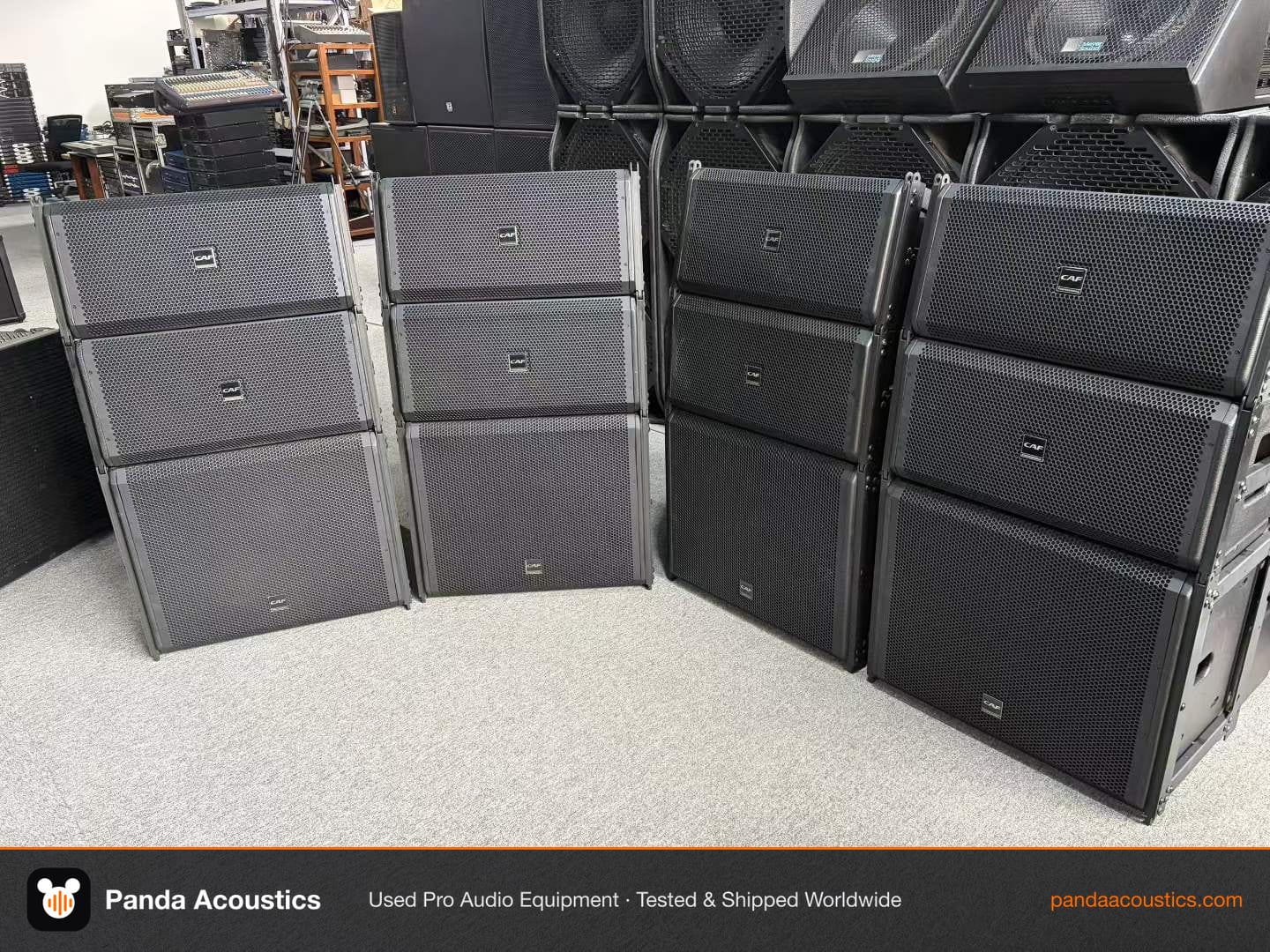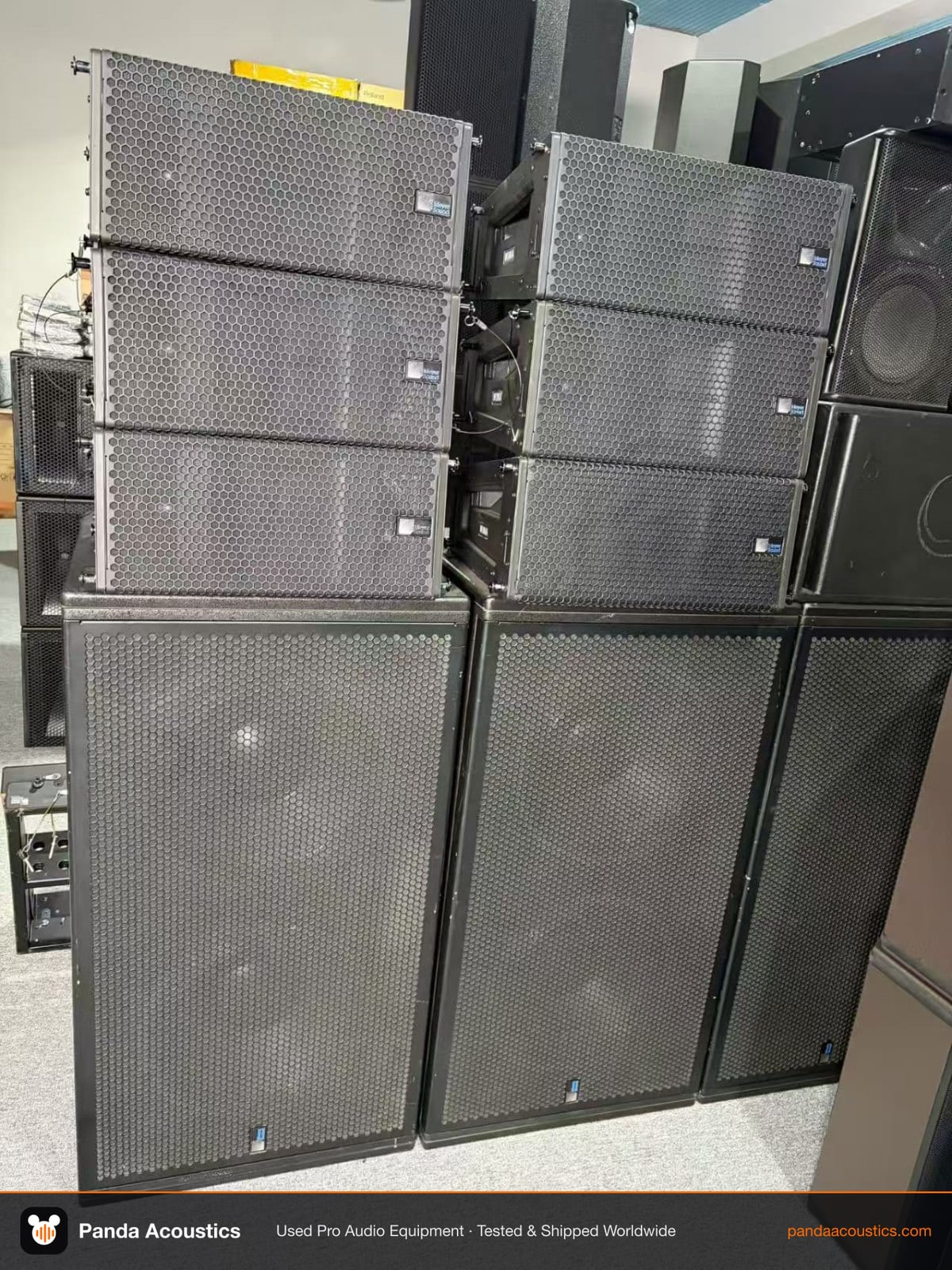
Used Meyer Sound MINA compact line array modules are available in Condition A from Panda Acoustics, with rigging frames and cabling included on some listings, but the per-unit price is not published and no warranty, lead time, or test data is disclosed. Whether the MINA is worth buying used from China depends on verifying amplifier module condition, rigging hardware wear, and lot consistency before you pay.
Key takeaways
- Three separate MINA listings appear in the catalogue, all graded Condition A (used), all in stock, and all with price not published.
- Listings reference the 600-HP amplifier module, hex-punched or honeycomb steel grilles, and rigging frames with safety steel cables on at least one listing.
- The published price range for this category is USD 1,200 to USD 6,000 per unit, which is a category range, not a MINA quote.
- Condition A is defined by the supplier's grading standard, not by a factory test certificate; read that page before assuming what A covers.
- No MOQ, warranty period, lead time, or certification is stated in the materials, so all four must be confirmed in writing.
The decision
You are a KTV operator, touring sound company, rental house, or club in Russia, the Middle East, South America, or Africa. You need compact line array modules in volume, and you are weighing a used Meyer Sound MINA lot from a China-based supplier against other used line array options. The decision is not whether the MINA is a good loudspeaker in the abstract; it is whether this specific lot, at this specific landed cost, is safe to pay for before you have heard it.
That decision has three parts: what Condition A actually means for the cabinets and rigging, what state the amplifier modules are in, and what the total landed cost will be once freight, duties, and any replacement parts are added. Only the first part is partly documented.
What the data says
The materials describe the MINA as a compact line array loudspeaker and, in one listing, as a self-powered line array module with NL4 connectors and a honeycomb metal grille. Another listing names the 600-HP amplifier module and a hex-punched steel grille in a black finish. A third listing adds rigging frames and safety steel cables fitted, with an amplifier module and cable connections on the rear panel.
Condition is listed as A (used) across the MINA listings. One listing is explicit that Condition A here includes scuffs and scratches on the cabinet and rigging hardware. That is a useful detail: it tells you the grade does not mean cosmetically new.
The category price range in the materials is USD 1,200 to USD 6,000 per unit. That range covers the line-array category, not a quoted MINA price. No MINA listing publishes a price, an MOQ, a warranty period, a lead time, or a certification.
Included accessories vary by listing: one includes rigging frames and cabling as shown, another includes rigging hardware and connection cables, and a third specifies rigging frames and safety steel cables fitted. Buyers comparing lots should compare what is actually in the crate, not just the cabinet count.
What the datasheet/docs don't tell you
Several things that matter for a bulk purchase are simply not in the materials. The per-unit MINA price is not disclosed. The MOQ is not disclosed. The warranty period is not disclosed. The lead time is not disclosed. Any certification is not disclosed. Those are not small gaps; they are the numbers you need to build a landed-cost model and a payment schedule.
More importantly, there is no published test data for the amplifier modules. The materials reference the 600-HP module and NL4 connectors, but they do not state measured output, distortion, frequency response, or whether the modules have been bench-tested. The supplier's inspection standard page describes the inspection process, but the materials do not give per-unit test results. That matters because a used self-powered module is the highest-risk part of the cabinet: a failed amplifier can cost more than the cabinet is worth.
Rigging hardware condition is also only partly described. One listing mentions scuffs and scratches on rigging hardware, and another mentions safety steel cables fitted. Neither states whether the rigging frames have been load-checked, whether pins and quick-locks are original, or whether any hardware has been replaced. For a flown array, that is a question you must ask directly.
Finally, lot consistency is not addressed. If you are buying ten or twenty modules, the materials do not say whether they come from a single inventory, whether grille types are mixed, or whether amplifier module revisions are matched. Mixed revisions complicate spares and service.
Who should not choose this
Do not choose this channel if you need a manufacturer warranty or a published factory test certificate before payment. The materials do not offer either. Do not choose it if you need a fixed per-unit price and a firm lead time before you commit; neither is published. Do not choose it if your project requires documented certification, because no certification is stated in the materials.
Also think twice if you cannot inspect or arrange third-party inspection before shipment. The MINA is a self-powered module with rigging hardware, and the materials make clear that Condition A can include cosmetic wear. If your business cannot absorb the cost of replacing an amplifier module or a rigging pin, a used bulk lot is the wrong starting point.
Comparison and trade-offs
Within the materials, the meaningful comparison is between the MINA listings themselves. Listing one specifies the 600-HP amplifier module, a hex-punched steel grille, black finish, and rigging frames and cabling as shown. Listing two specifies black color, hex-punched steel grille, rigging frames and safety steel cables fitted, and an amplifier module with cable connections. Listing three describes a self-powered line array module with NL4 connectors, honeycomb metal grille, Condition A with scuffs and scratches on cabinet and rigging hardware, and rigging hardware and connection cables included.
The trade-off is between completeness and certainty. A listing that includes rigging frames and safety cables reduces your rigging spend, but it does not tell you the condition of those parts. A listing that names the 600-HP module gives you a service reference, but it does not give you test results. None of the listings publishes a price, so you cannot compare cost per module from the materials alone; you can only compare what is included.
The category price range of USD 1,200 to USD 6,000 per unit is the only price anchor in the materials. Treat it as a budgeting band, not a quote. For a bulk order, the difference between the low and high end of that band is large enough that freight and spares can change the ranking of suppliers.
Implementation / next step
Before paying, request a written lot sheet for the exact MINA modules you are buying. It should list serial numbers or inventory references, amplifier module type, grille type, what rigging hardware is included, and any known cosmetic or functional defects. Ask for the supplier's inspection report for those specific units, not the general inspection standard.
Then ask three direct questions in writing: what is the per-unit price for this lot, what is the MOQ, and what is the lead time to your port. Ask separately whether any warranty is offered and on what terms. If the answers are verbal only, treat them as not confirmed.
Use the supplier's published pages to frame the questions: read the condition grading standard so you know what Condition A is meant to cover, read the inspection standard so you know what the inspection process includes, and read the shipping and logistics page before you build a landed-cost estimate. Then compare the three MINA listings directly: MINA listing one, MINA listing two, and MINA listing three.
Your concrete next step: send the supplier a written request for the lot sheet, per-unit price, MOQ, lead time, and warranty terms for the specific MINA modules you intend to buy, and do not release payment until those answers are in writing and the inspection report covers the exact units in the lot.