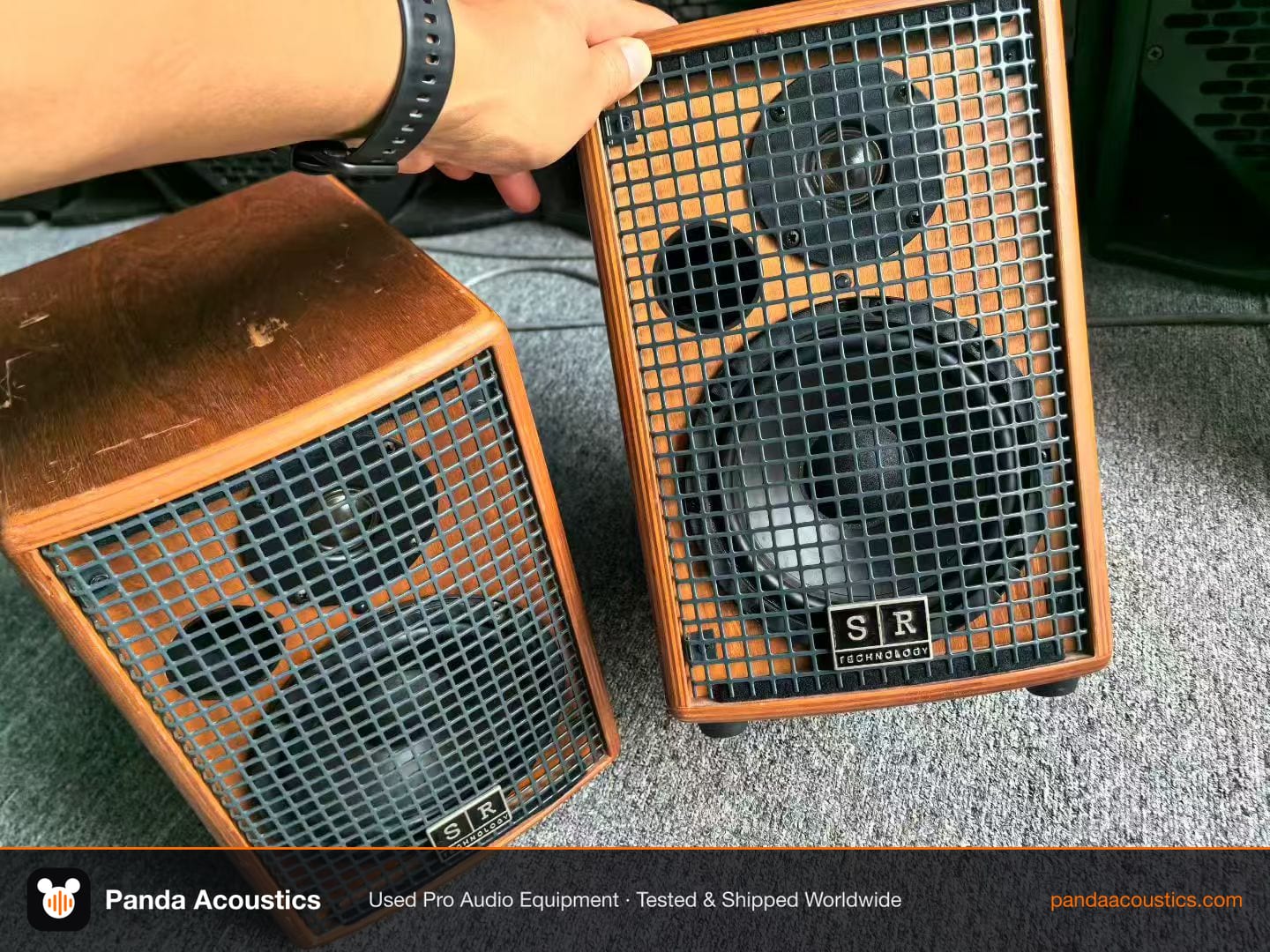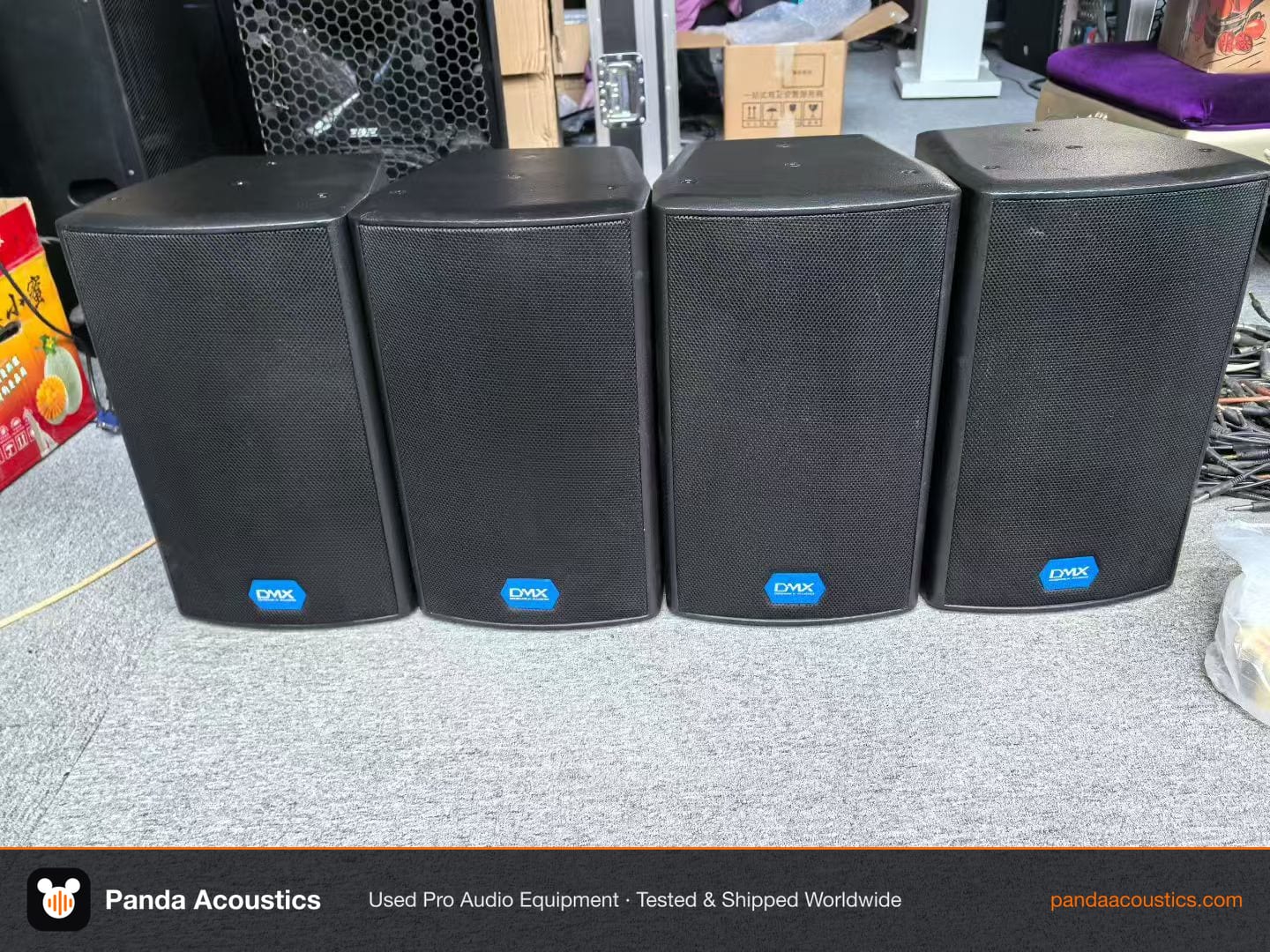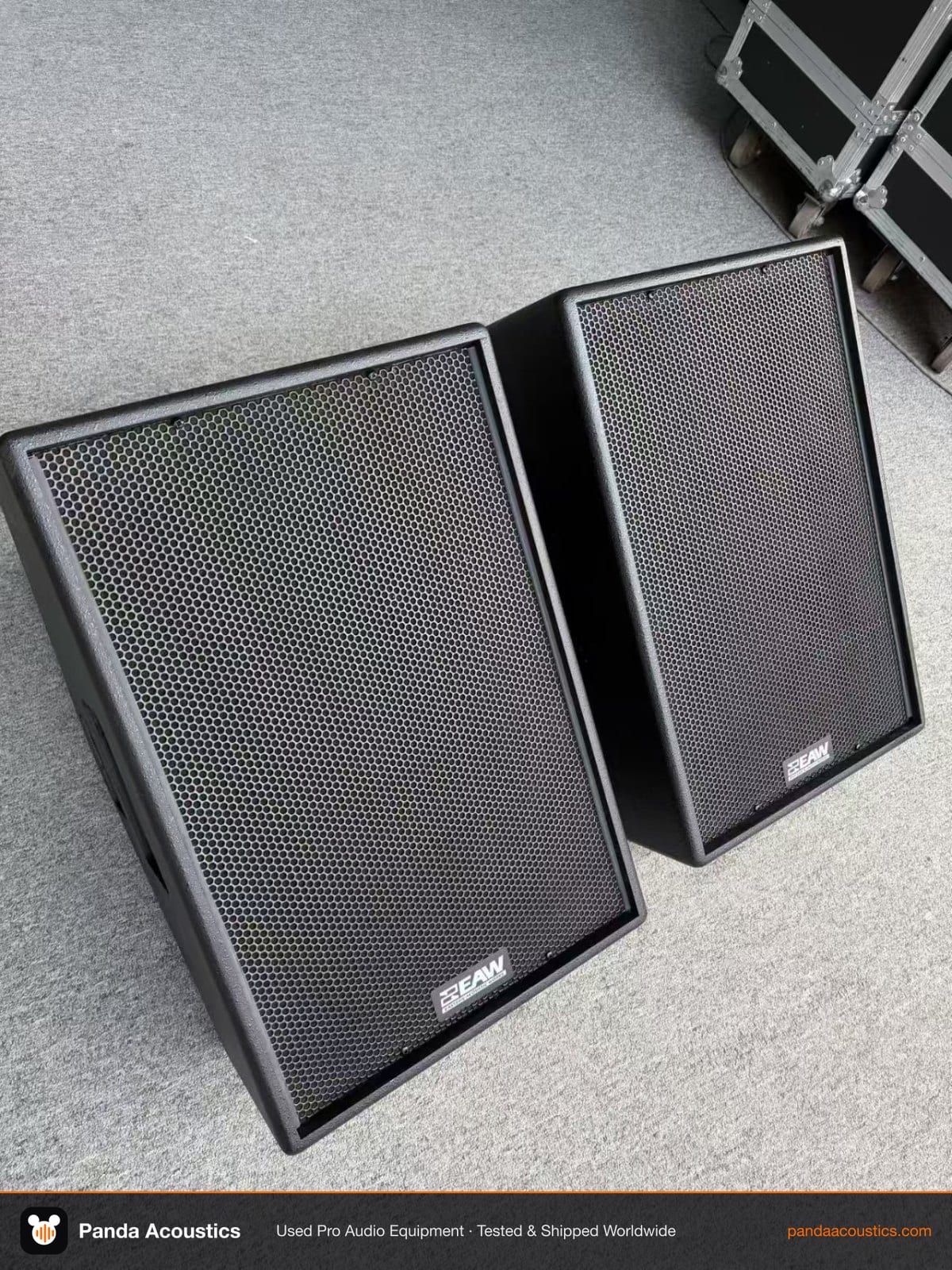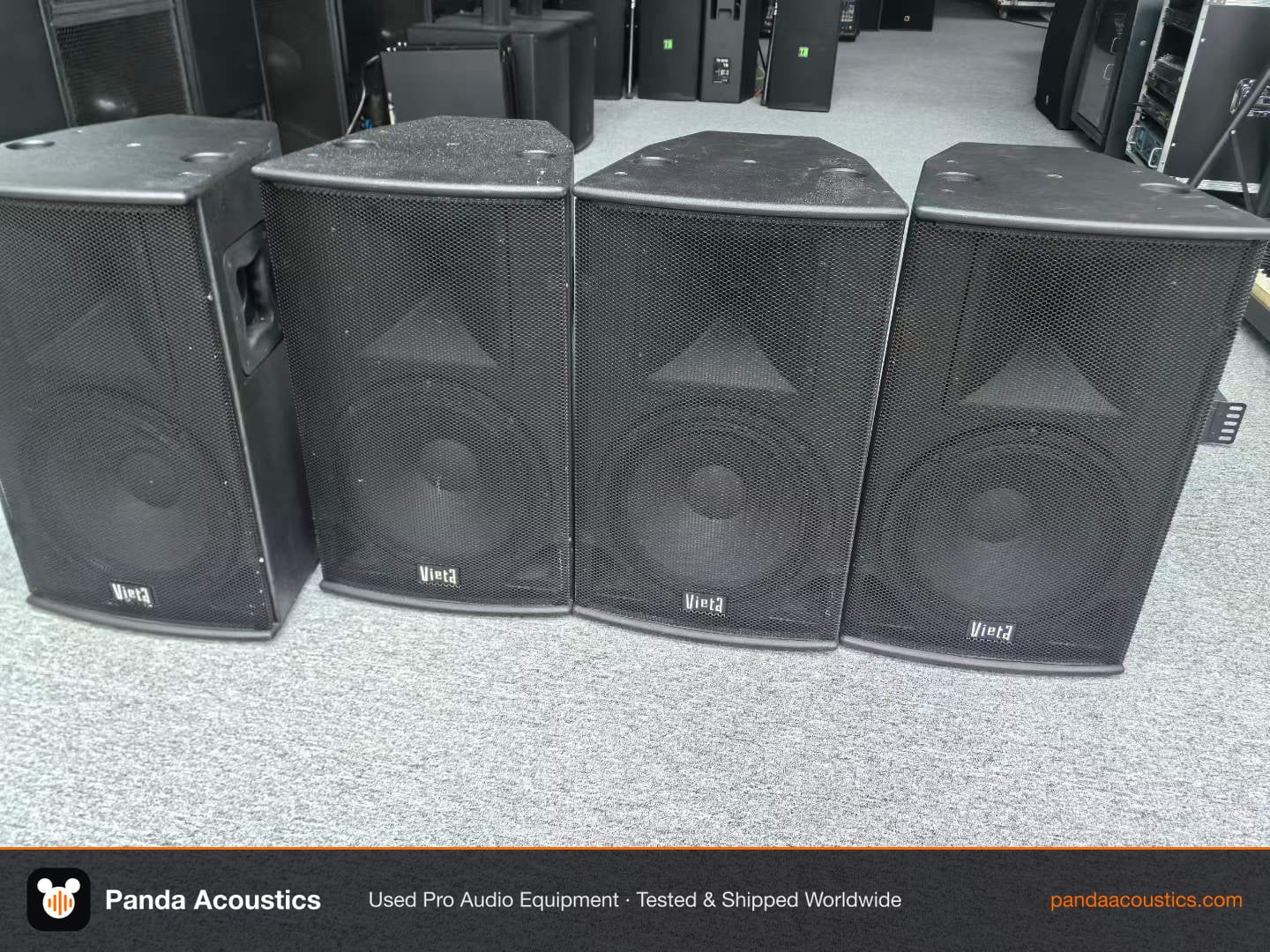
The number of speakers for a KTV room is not a single fixed figure. A small private room typically uses two main speakers plus one subwoofer, while larger rooms need additional speakers for even coverage. The exact count depends on room volume, seating layout and how loud the room must run.
Key takeaways
- Two main speakers plus one subwoofer is a common starting point for a small private KTV room; larger rooms need more coverage points.
- Speaker count scales with room volume and seating, so a venue with many rooms multiplies the per-room figure.
- Used speakers must be checked for impedance and power handling before you commit to a count, because mismatched units change the amplifier load.
- Condition grade matters in bulk: Grade A units are the baseline for resale or rental fleets.
- Total landed cost, not unit price alone, decides whether used units from China make sense.
The decision
You are fitting out or refreshing a KTV venue, or building a rental fleet for KTV operators. You need to know how many speakers each room requires so you can multiply that figure across the venue and place a bulk order. The decision in front of you is whether to specify a standard per-room speaker package and source it used from China, or to buy new at a higher unit cost.
That decision has two parts. First, the per-room speaker count and model mix. Second, whether used units in Grade A condition are a sound buy at volume. Both parts need evidence before you pay.
What the data says
The materials available to us do not contain a formula for speaker count per room, and they do not publish room-size tables. What they do give is real specification data on used speaker models that fit KTV and small-venue use.
The Vieta VT-12 is a two-way full-range speaker rated at 250W RMS with 8Ω impedance and 2x Speakon IN/OUT connectors. It belongs to the VT-series and is made in the EC. Its crossover uses GDSL1017 1.4mH/5A and GDSL1006 0.5mH/5A inductors.
The JBL CMX6403 is a column array speaker rated at 8 ohms impedance. Column arrays suit rooms where you want controlled vertical coverage rather than a wide point source.
The RCF ART 310A is an active two-way speaker sold as a pair. Its compression driver is the ND1411-M ART 310A, and its crossover uses ROYAL403 20W 6.25J and ROYAL573 20W 2.5J capacitors.
The Meyer Sound HD-1 is a high definition audio monitor with XLR input, voltage options of 90-130 V / 200-250 V, and fuse ratings of 5 A / 3.15 A. Serial number 07342740 is listed.
The Dynaudio Acoustics BM5 is a two-way studio monitor pair with 4 ohms nominal impedance and amplifier power of 50-100 RMS watts. It is made in Denmark.
The Barefoot Sound MicroMain27 is an active studio monitor pair, hand crafted in the USA, with XLR inputs and a volume control. It is Grade A with minor dust and light handling wear.
Price range across this speaker category is USD 200 to USD 1,500 per unit. Individual product prices are not published. Stock status for all six models is in-stock, and all are Grade A condition.
What the datasheet/docs don't tell you
The materials do not state a speaker-count formula, room-volume chart, or coverage angle for any model. That means the per-room count is Unknown from the data alone and must be derived from the room itself.
Sensitivity, maximum SPL and dispersion are Not disclosed for these listings. Without those figures you cannot calculate how loud a room will run or how far apart speakers can be placed before a gap appears in coverage.
Individual unit prices are Not disclosed; only the category range of USD 200-1,500 per unit is published. MOQ, warranty period, lead time and certification are Not applicable in the materials. Do not assume any certification exists.
Why this matters: a speaker count that ignores sensitivity and dispersion can leave a room under-covered at the back, or over-driven at the front. For a venue with many rooms, that error multiplies across every room you fit.
Who should not choose this
Do not choose used speakers from this category if you need a guaranteed fixed speaker count per room delivered as a turnkey package. The materials do not provide a room-sizing formula, so you would be guessing.
Do not buy if you cannot verify impedance and power handling before payment. Mixing a 4Ω monitor like the BM5 with an 8Ω model like the VT-12 or CMX6403 on the same amplifier changes the load, and the materials do not tell you what amplifier each unit was paired with.
Do not buy if you require published certification or a stated warranty period. Neither appears in the materials.
Comparison and trade-offs
Within the materials, the trade-offs are about impedance and format, not brand claims.
- Vieta VT-12: 250W RMS, 8Ω, passive two-way with Speakon IN/OUT. A practical full-range option for a KTV room where you want a passive unit and a known power rating.
- JBL CMX6403: 8Ω column array. Suits rooms where vertical coverage control matters more than a wide point source.
- RCF ART 310A: active two-way, sold as a pair. Active design removes the need for a separate amplifier decision per unit.
- Dynaudio Acoustics BM5: 4Ω, 50-100 RMS watts. Lower impedance and lower power than the VT-12, so it suits smaller, quieter spaces.
- Meyer Sound HD-1 and Barefoot Sound MicroMain27: monitors with XLR inputs, suited to reference or control-room use rather than main KTV playback.
The trade-off is straightforward: passive units like the VT-12 give you a known RMS rating and 8Ω load, while active units like the ART 310A simplify installation. Monitors like the BM5, HD-1 and MicroMain27 are a different tool and should not be counted as main room speakers.
Implementation / next step
Before you pay, do three things. First, measure each room and decide the speaker positions, then set a per-room count and multiply it across the venue. Second, confirm the impedance and power rating of every model you intend to buy, using the listings. Third, review the inspection standard and the condition grading standard so you know what Grade A means for your order.
Then browse the speaker category page and shortlist the models that match your per-room count and impedance plan. Request the inspection record for each shortlisted unit before payment.