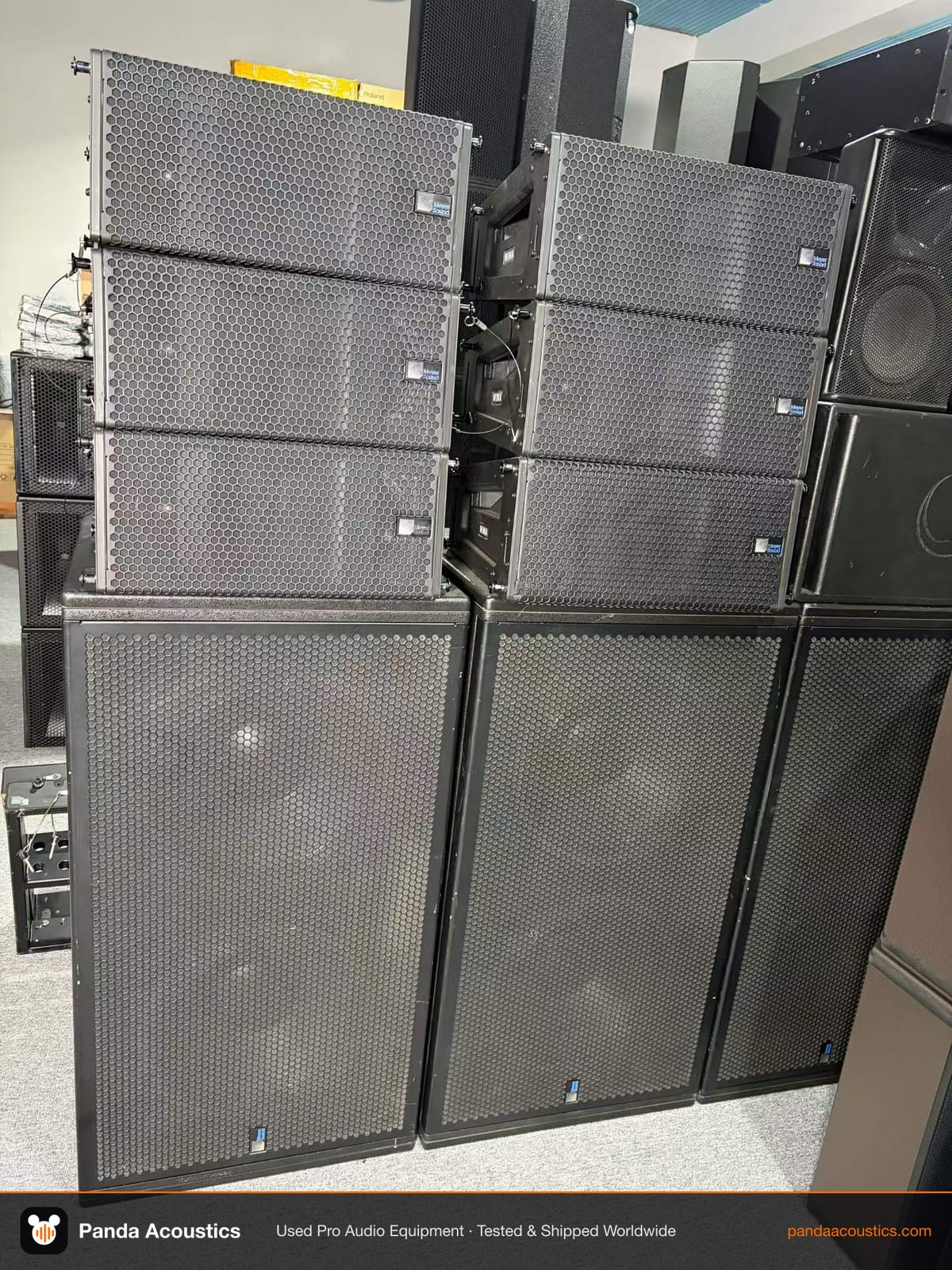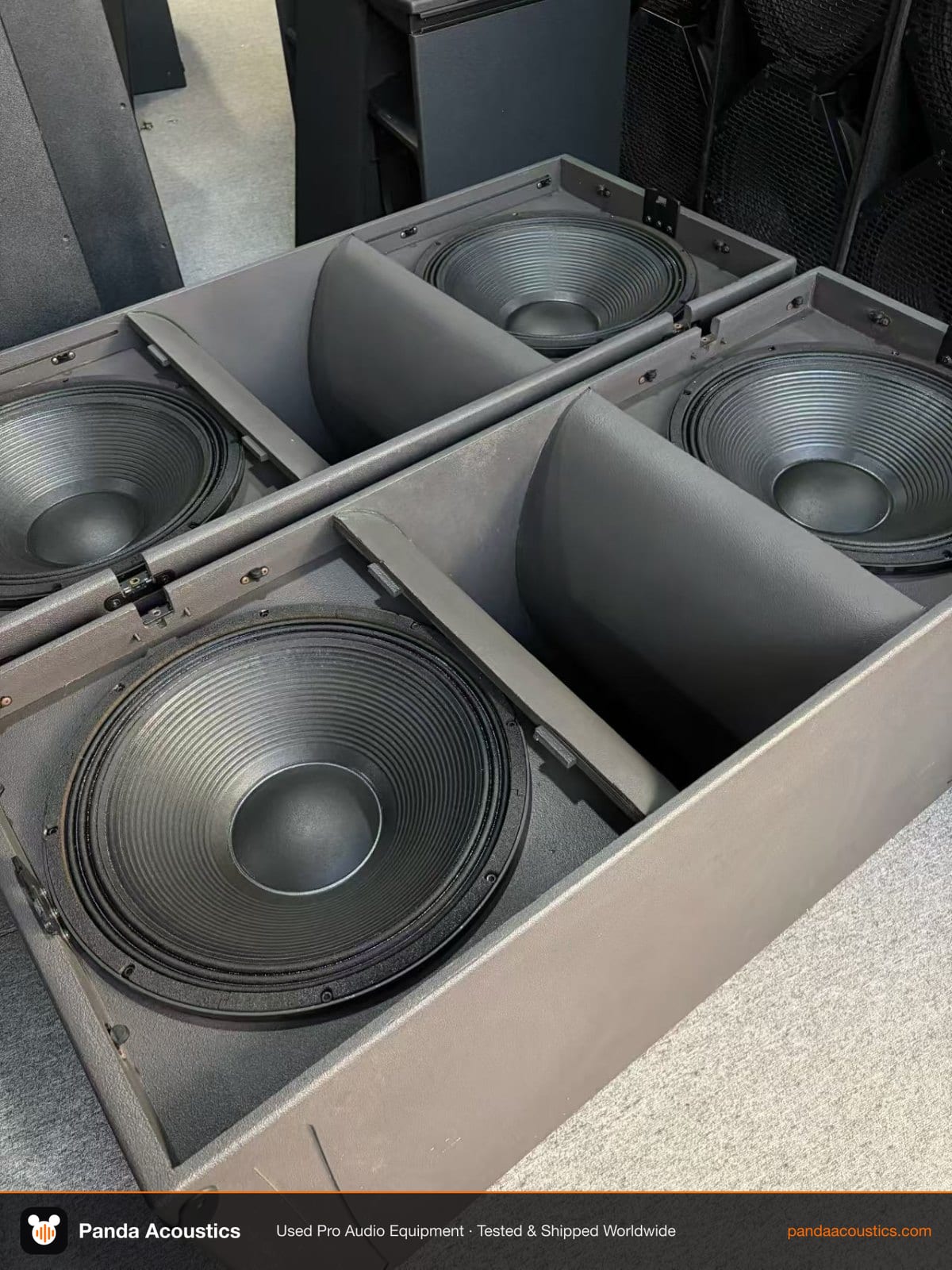
When you are buying used subwoofers in volume for a KTV, bar, or touring rig, the only thing that matters is whether the driver and cabinet will survive the next few years of heavy use. Marketing photos and seller descriptions are irrelevant. You need a repeatable test procedure that you can run on-site or via video call. This guide walks through the physical and acoustic checks that separate a good used subwoofer from a paperweight.
1. Physical Inspection: Cabinet, Cone, and Suspension
Start with the cabinet. Look for cracks in the plywood, especially around the baffle and rear panel joints. Water damage shows as swelling, soft spots, or a musty smell. Check the corners and edges for impact damage that could indicate the cabinet was dropped. If the subwoofer has a removable grille, take it off and inspect the cone. Push gently on the cone with two fingers spread apart. You should feel smooth resistance from the spider and surround. Any scraping, rubbing, or grating noise means the voice coil is misaligned or the former is damaged. Look at the surround (the foam or rubber ring connecting cone to frame). Foam surrounds dry out and crack with age; rubber surrounds last longer but can still tear. A cracked surround will cause distortion at high output and will fail soon.
Check the terminals and wiring. Corroded or loose terminals add resistance and can cause intermittent dropouts. If the subwoofer has a built-in amplifier, inspect the amp panel for burn marks, swollen capacitors, or a burnt smell. For passive subwoofers, measure the DC resistance of the voice coil with a multimeter. A healthy 8-ohm driver typically reads around 6 to 7 ohms DC. A reading of 0 ohms means a shorted coil; infinite resistance means an open coil. Either way, the driver is dead. If the subwoofer has dual voice coils, test each coil separately.
2. Acoustic Testing: Sweep, Tone, and Music
Physical checks catch obvious problems, but you also need to hear the subwoofer under controlled conditions. Bring a test tone generator or use a phone app that can produce sine sweeps and fixed frequencies. Connect the subwoofer to a known-good amplifier that can deliver enough power for the driver. Start with a low-level sine sweep from 20 Hz to 200 Hz. Listen for any buzzing, rattling, or popping that does not come from the room. A clean subwoofer will reproduce the sweep smoothly. If you hear a rattle at a specific frequency, it could be a loose part inside the cabinet or a damaged voice coil. Next, play a fixed tone at the subwoofer's resonant frequency (often around 40 to 60 Hz for large PA subs). Turn up the level gradually and watch the cone movement. The cone should move in and out smoothly without bottoming out or making mechanical noise. If the cone freezes or makes a scratching sound, stop immediately.
Finally, play music with strong, continuous bass content. Use familiar tracks that you know have deep, clean low end. Listen for distortion, flapping, or a lack of output. Compare the tested subwoofer to a known-good unit of the same model if possible. If you are buying multiple units, test each one individually. Do not assume that because one works, the others are fine. For high-value models like the L-Acoustics KS28, a full test with a measurement microphone and analyzer is ideal, but even a basic sweep and music test will reveal major faults.
3. Testing Amplified Subwoofers
Many used subwoofers for KTV and bar systems are self-powered. In that case, you need to test the amplifier module as well as the driver. Power on the unit and listen for the soft thump or click that many amps make when the relays engage. If you hear nothing, check the fuse and power switch. With no input signal, turn the level up and listen for hum or hiss. Some noise is normal, but loud hum indicates a grounding or filter problem. Feed a signal into the input and confirm that the output is clean and matches the level control. Test any built-in crossover or DSP by sweeping through the crossover point and listening for a smooth transition. If the subwoofer has a limiter, drive it into limiting briefly to confirm the circuit engages and releases properly. Any crackling or dropouts suggest failing components.
4. Common Scams and Hidden Defects
Some sellers will hide defects by playing only soft music or by keeping the subwoofer at low volume. Insist on a full-range sweep and a high-level music test. If the seller refuses, walk away. Another trick is to replace a blown driver with a cheap aftermarket one. Check that the driver is original by comparing the frame, magnet, and cone to manufacturer photos. A non-original driver may not match the cabinet tuning and will not perform as expected. Also, look for signs of re-coning, such as excess glue around the surround or dust cap. A professional re-cone can be fine, but a poor job will fail under load.
If you are buying remotely, ask for a live video call where the seller performs the sweep and music test while you watch. Request that they show the multimeter reading on the voice coil. This is not foolproof, but it filters out the most blatant problems. For container-load purchases, consider hiring a local technician to inspect the goods before they ship. The cost of an inspection is small compared to the cost of receiving a container full of dead subwoofers.
5. Documenting Condition and Making the Decision
As you test each subwoofer, write down what you find: DC resistance, any mechanical noise, cosmetic damage, and whether the amplifier works. If you are buying a large batch, test a sample from the lot. If one unit has a blown driver, the odds are high that others do too. Use your findings to negotiate. A subwoofer that needs a re-cone is worth less than one that is ready to work. Do not pay a premium for a unit that has not been tested. Remember that used gear from touring companies may have been driven hard, but well-maintained units from reputable rental houses can still deliver years of service. The key is to verify condition, not to trust the label.
For more detailed checklists on specific models and buying scenarios, see our B2B subwoofer buying guide and used PA subwoofer guide. If you are considering L-Acoustics KS28 subwoofers, our KS28 buyer guide covers model-specific points. Always test before you buy, and buy from sellers who allow thorough inspection.