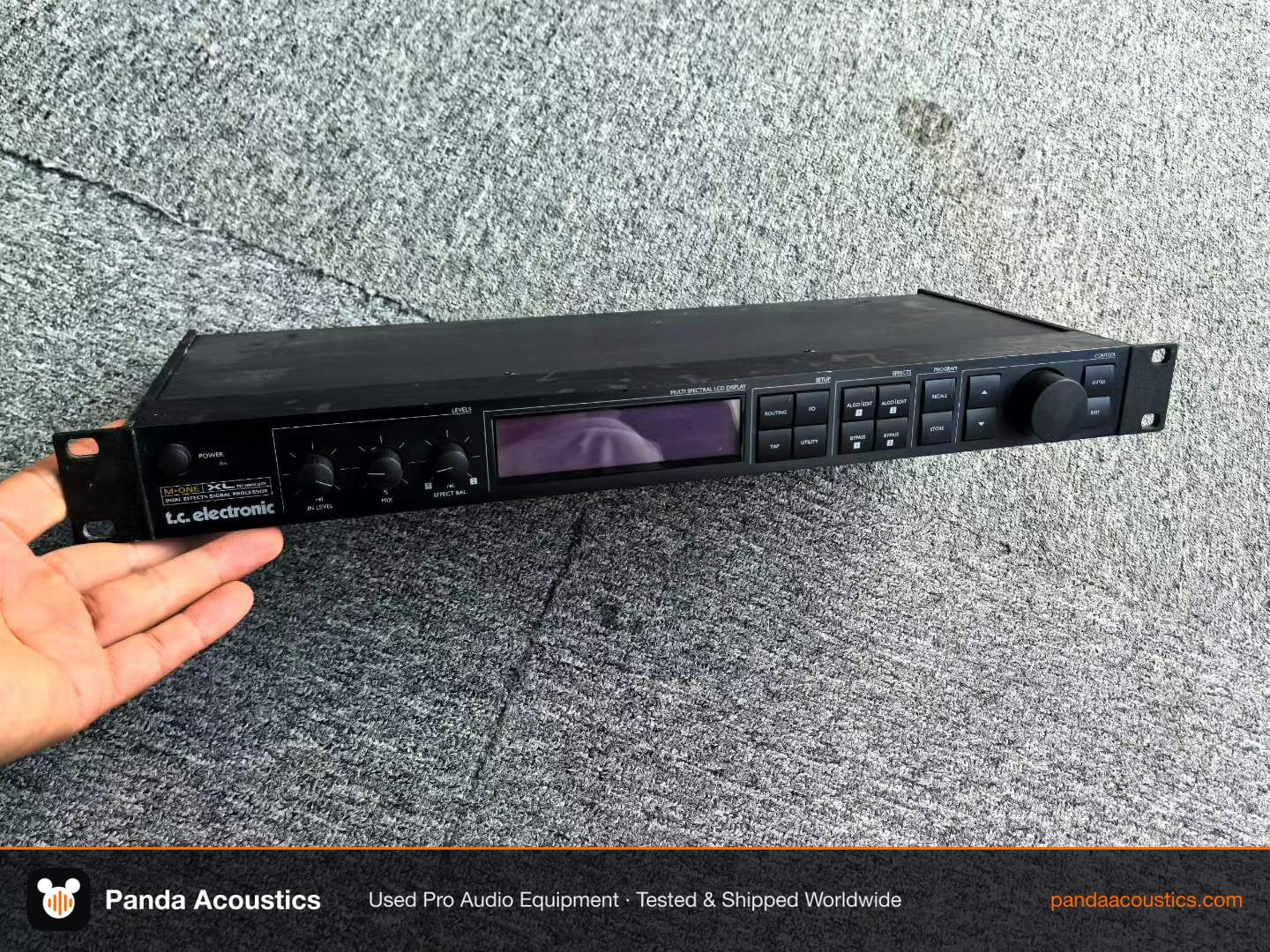
A used audio DSP processor is a digital signal processing unit that shapes and routes audio — effects, dynamics and output management — and buying one used in bulk from China is reasonable only if the seller publishes a condition grade and an inspection standard and lets you verify the unit's inputs, outputs, digital sync and MIDI before you pay. For the t.c. electronic M-ONE XL specifically, the published spec sheet lists 2x XLR balanced inputs, 2x XLR balanced outputs, S/PDIF coaxial RCA in/out, MIDI In/Thru/Out and a Multi Spectral LCD — those are the points to confirm on the actual unit, not on the listing photo.
Key takeaways
- Used audio DSP processors in the Panda Acoustics catalogue sit in a per-unit price range of USD 300 to USD 2,000; the M-ONE XL price is not published.
- The M-ONE XL is listed in condition grade A and marked in-stock, but grade A is defined by the condition grading standard, not by the word 'tested' alone.
- Published I/O on the M-ONE XL is 2x XLR balanced in, 2x XLR balanced out, S/PDIF coaxial RCA in/out and MIDI In/Thru/Out — every one of these is a physical check, not a spec-sheet assumption.
- Warranty period, MOQ, lead time and certification are not disclosed in the materials, so do not assume any of them.
- Verify against the inspection standard before paying, and confirm payment and shipping terms in writing.
The decision
You run a KTV chain, a touring sound company, a rental house or a bar/club in Russia, the Middle East, South America or Africa. You are buying processors in volume, not one at a time, and you care about two things: real condition and total landed cost. A DSP processor is the box that holds your system's routing and effects together, so a failed unit in a bulk order is not a cosmetic problem — it is a dead channel in a venue.
The decision in front of you is not 'is a DSP processor useful'. It is: is this specific used unit, from this specific supplier, in a condition I can verify, at a landed cost that still beats new? That decision should be made on evidence, not on the model name.
What the data says
Only the following facts are published in the materials for this category and product.
- Category: processor. Per-unit price range: USD 300 to USD 2,000.
- Product: t.c. electronic M-ONE XL Dual Engine Effects Processor.
- Condition: grade A. Stock status: in-stock. Price: not published.
- Inputs: 2x XLR balanced (L/R). Outputs: 2x XLR balanced (L/R).
- Digital I/O: S/PDIF coaxial RCA in/out. MIDI: In / Thru / Out. Display: Multi Spectral LCD.
- Supplier: Panda Acoustics (Beijing Panda Acoustics Technology Co., Ltd.), selling tested used professional audio equipment in bulk to overseas B2B buyers.
That is the whole published data set. Anything not on this list — warranty, MOQ, lead time, certification, test results per unit — is not in the materials and should be treated as unknown until the supplier states it in writing.
What the datasheet/docs don't tell you
The spec sheet tells you what ports exist. It does not tell you the condition of those ports on the unit you are buying. Specifically, the materials do not disclose:
- Warranty period — Unknown. If a unit fails in month two, you have no published recourse unless it is agreed in writing.
- MOQ — Not disclosed. Bulk pricing tiers are Not applicable until quoted.
- Lead time — Not disclosed. Do not plan a venue install around an assumed ship date.
- Certification — Not disclosed. No CE, RoHS, UL, FCC or ISO claim appears in the materials, so do not assume any for import clearance.
- Per-unit test results — Not disclosed. Grade A is a condition grade, not a per-port test report.
Why this matters: a DSP processor is a routing hub. A dead XLR jack, a noisy S/PDIF input or a non-latching MIDI Thru will not show up in a listing photo, and it will show up in a venue at the worst moment. The gap between 'grade A' and 'every port works on my unit' is exactly the gap you are paying to close before payment, not after.
Who should not choose this
Do not buy this if you need a published factory warranty, a fixed lead time, or a named certification for customs — none of those are disclosed in the materials, and a used unit will not create them.
Do not buy this if you cannot verify the unit before paying. If the supplier will not let you confirm the XLR inputs and outputs, the S/PDIF coaxial in/out, the MIDI In/Thru/Out and the Multi Spectral LCD against a documented inspection standard, walk away. A grade A label alone is not verification.
Do not buy this if your project is a single small bar where one processor is the whole system and downtime is fatal — a used unit with no published warranty is a poor fit for a single point of failure.
Comparison and trade-offs
Within the materials, the only comparison that can be made honestly is between the published price band and the published product data. The category range is USD 300 to USD 2,000 per unit; the M-ONE XL price is not published, so you cannot place it inside that band from the materials alone — ask for a quote.
Trade-off one: price versus verification. A unit at the low end of the band is only a good deal if the inspection standard was actually applied to it. Cheap plus unverified is the worst combination in bulk buying.
Trade-off two: features versus failure points. The M-ONE XL has analog XLR, S/PDIF and MIDI paths. Each is useful and each is a thing that can fail. More I/O means more to check — budget inspection time per unit, not per shipment.
Trade-off three: grade versus test evidence. Grade A is a published condition grade; it is not a per-unit test report. If your venue cannot tolerate a dead channel, ask for the test evidence that sits behind the grade.
No competitor model, brand, spec or price is compared here because none appears in the materials.
Implementation / next step
Before you pay, do these in order. First, open the processor category page and the M-ONE XL listing and confirm grade and stock status in writing. Second, request the inspection record for the specific units in your order and check it against the inspection standard — inputs, outputs, digital I/O, MIDI and display. Third, confirm payment terms and shipping terms in writing, and get the landed cost to your port, not just the unit price. Fourth, ask explicitly for warranty, MOQ and lead time in writing; if any is not disclosed, treat it as absent.
Next step: request a written quote and the inspection record for the M-ONE XL units you intend to buy, and compare the landed cost against the USD 300–2,000 per-unit band before committing.